Introduction In football, it is a common misconception that scoring is dictated solely by a striker’s finishing technique. However, modern data analytics and sports science research suggest a different reality. According to advanced performance analysis literature, the primary determinant of conversion rate efficiency is not the strike itself, but the “Pre-shot Context” and “Spatial Occupation” achieved prior to the attempt.
Fundamental studies on Expected Goals (xG) models demonstrate that a goal is often decided not at the moment of impact, but in the split-second movements and positioning that precede it. High-probability chances are not accidents; they are the result of calculated movement and optimal space creation.
In this context, Erling Haaland stands as the ultimate case study. While renowned for his physical dominance, his true lethality lies in the unseen phase of the game. This analysis deconstructs Haaland’s scoring sequences to examine how he leverages biomechanics and spatial awareness to maximize scoring probability, proving why he is not just a striker, but a master of statistical dominance.
Expected Goals (xG) & Shot Quality: Rathke, A. (2017). An examination of expected goals and shot efficiency in soccer.
Pitch Control: Spearman, W., et al. (2017). Physics-based modeling of pass probabilities in soccer.
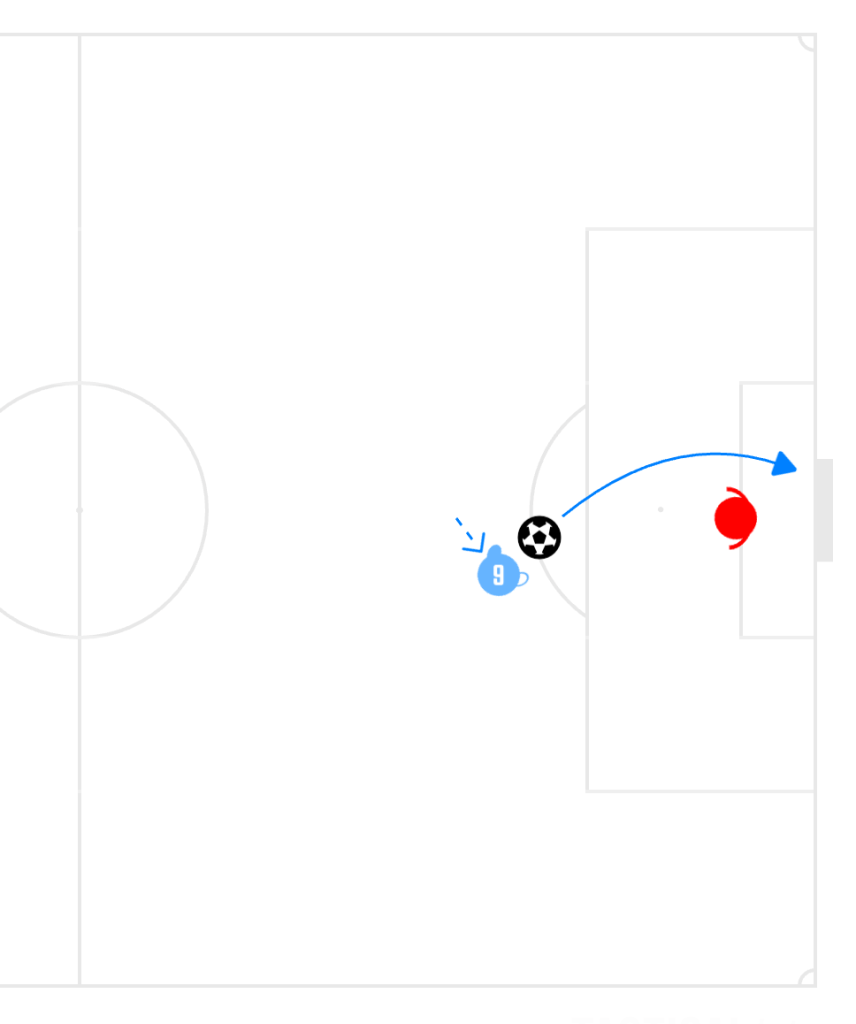
1. Pre-Shot Mechanics (Micro-Adjustment)
The slight movement to the right immediately before the shot is a critical micro-adjustment. This action opens up his hips, widening the swing arc of his left leg and maximizing the contact surface on the ball for a cleaner strike.
- Targeting the Low Far Corner: Haaland frequently aims for the bottom left. This generates an ‘Out-to-In’ trajectory, forcing the goalkeeper to cover a larger saving envelope.
- Technical Stability: Biomechanically, driving the ball low is more stable than aiming for the top corners, significantly reducing the margin for error and increasing the overall conversion rate.
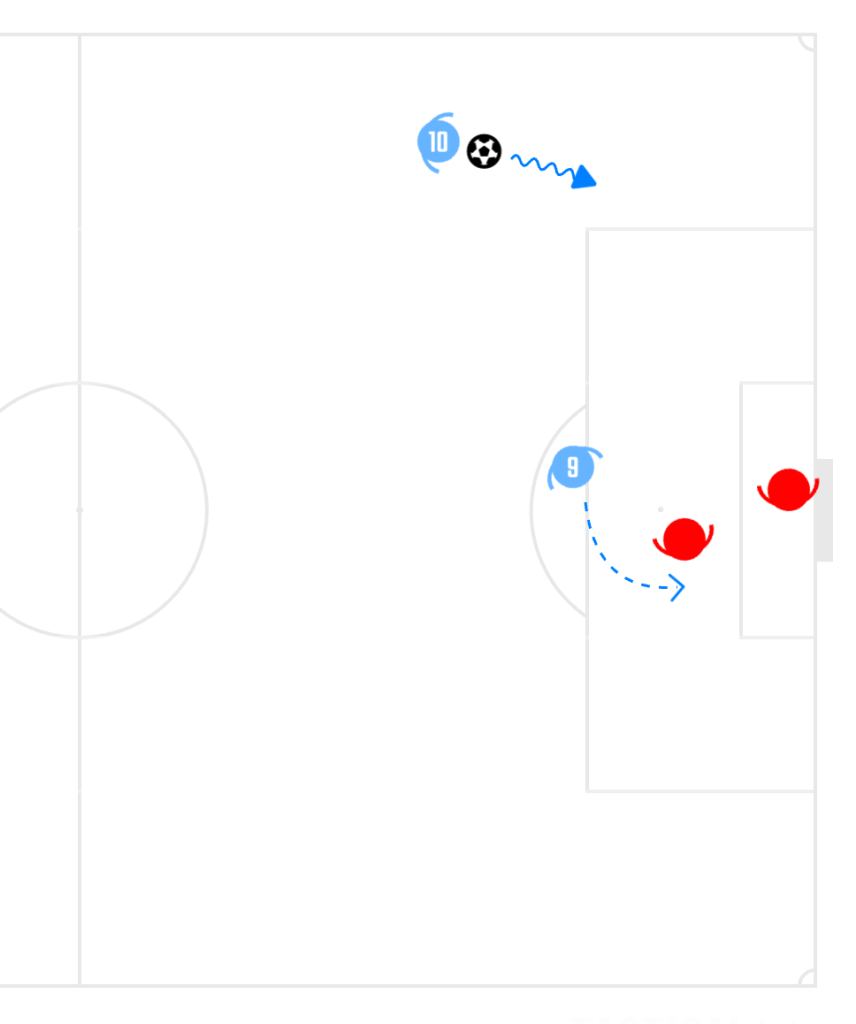
2. Far-Post Movement (Blind Side Exploitation)
2-1. Vision & Reactionary Gap: By peeling off to the far post when the ball is wide, Haaland positions himself on the defender’s blind side. This creates a split-second advantage. If the defender tracks him, the central channel opens up; if the defender holds position, they lose visual contact with Haaland, delaying their reaction.
2-2. Maximizing Catchment Area: A linear run to the near post or center limits the ability to adjust to overhit crosses. However, drifting to the far post expands the effective receiving radius, allowing him to attack both short and long deliveries.
2-3. Optimal Body Orientation: This position keeps the ball, defender, and goal within a single field of view. It allows Haaland to face the play with an open body shape, enabling him to redirect the ball with precision rather than attempting a difficult contact from a closed angle.
2-4. Anticipating Second Balls: The far post is the statistical hot zone for rebounds.
Positioning here maximizes the probability of capitalizing on second balls, particularly when a teammate drives a low shot towards the far post.
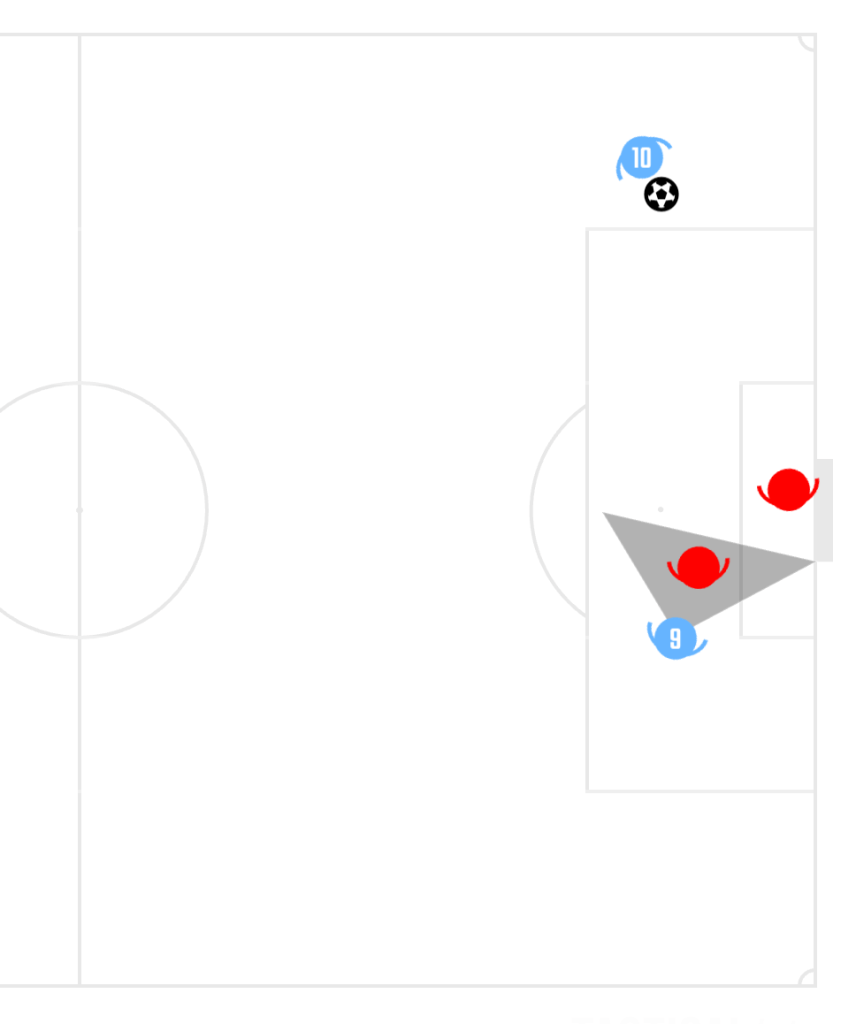
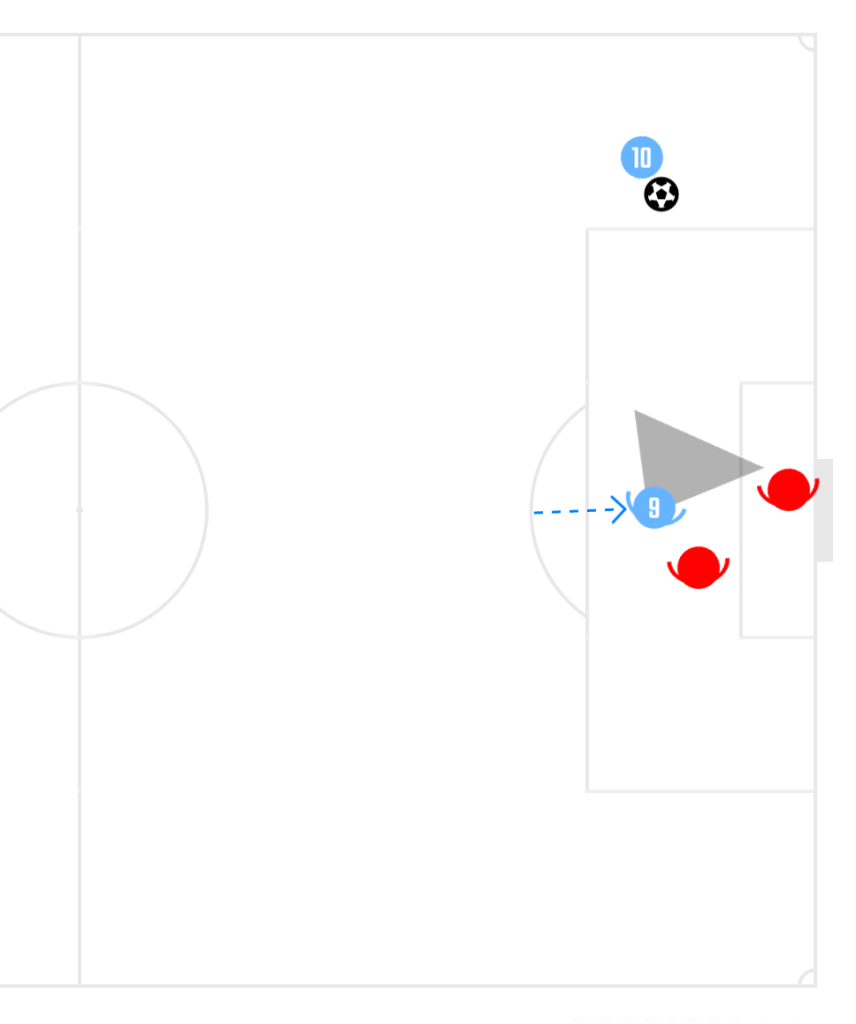

3. Penetration Movement (Line Breaking)
When a teammate drives forward, a defender is forced to step out to engage. Haaland exploits this by moving behind the stepping defender. This ensures he stays onside while allowing him to receive the ball ahead of his original marker.
In this diagonal run, the defender is facing away from the goal and must turn their body to chase, often resulting in suboptimal steps. Conversely, Haaland is sprinting face-forward, inevitably guaranteeing him a speed advantage over his opponent.
4. Creating Separation (Space Creation)
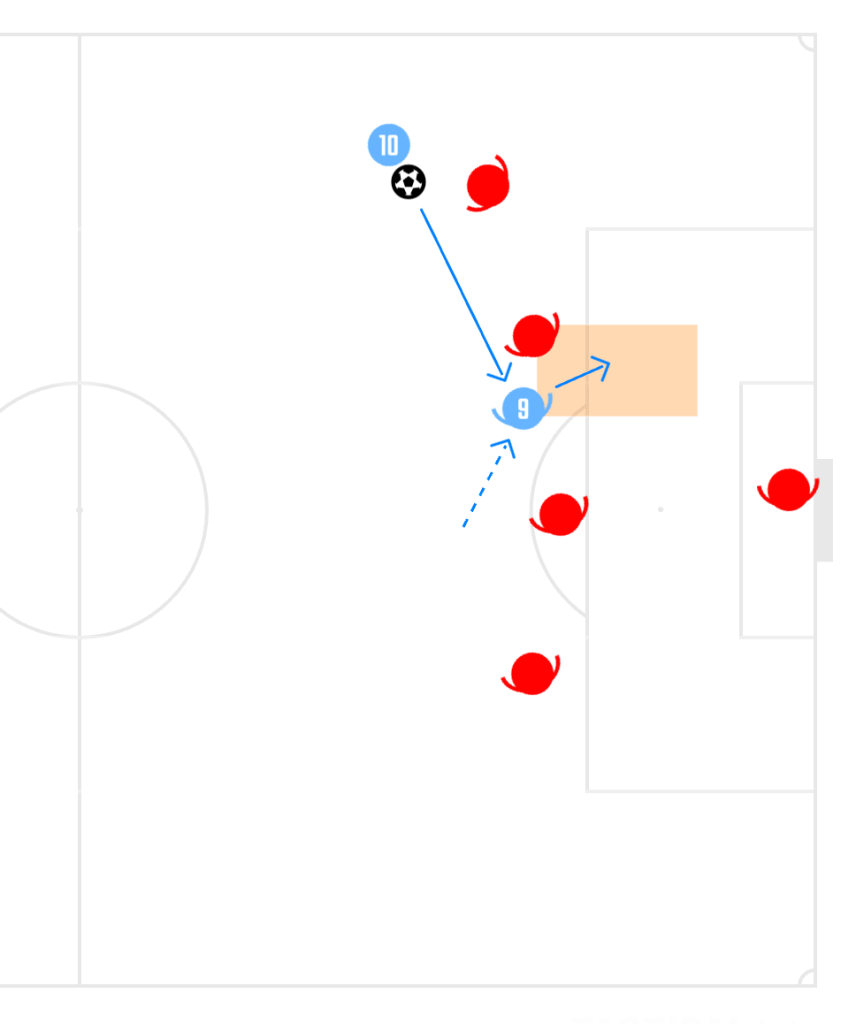
- 4-1. Blind-Side Approach & Pinning: In diagonal pass scenarios, Haaland approaches from the center-back’s blind side.
- Defensive Dilemma: The near-side CB is ball-watching, while the far-side CB hesitates to leave the central zone exposed.
- The Set-up Touch: Upon receiving, Haaland directs his first touch across the near-side defender’s path. This effectively pins the defender behind him. Since Haaland has established a shielding position, any defensive intervention risks a penalty, creating a clear shooting window before the far-side defender can arrive to cover.
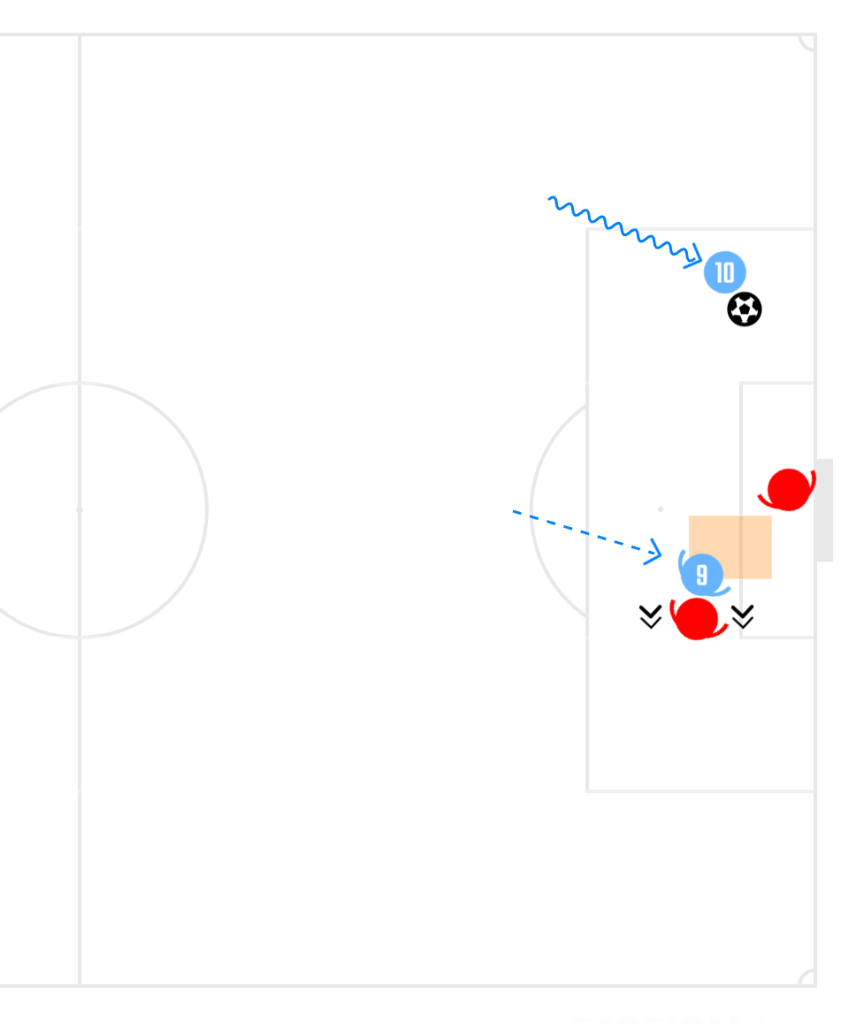
4-2. Creating Separation via Physicality (Contact & Displacement): Haaland intentionally initiates physical contact—leveraging his massive frame to drive the defender back—to create shooting space.
Off-Balancing the Defender: If there is no contact, the defender can extend a leg to block. However, by physically displacing the defender with his body weight, Haaland disrupts their balance and momentum. This renders the defender “heavy-legged” and restricted, generating the critical yard of separation needed to execute the finish.
Scientific Basis & References
1. Biomechanics of Shooting: Geometry & Kinematics
- Geometric Probability (Vertical Margin for Error): According to research on projectile motion in soccer, aiming for the top corner requires a precise launch angle (<15°). In contrast, low drives remain effective across a much wider angular range, significantly increasing the probability of hitting the target (Lees & Nolan, 1998).
- Goalkeeper Kinematics (Center of Mass): Biomechanical studies indicate that “collapsing” the body to reach low shots requires a complex sequence of lowering the center of mass (COM). This process is physically slower than the extension mechanism used to reach high shots, particularly for tall goalkeepers (Van der Kamp et al., 2018).
2. Cognitive Psychology: Visual Perception & Reaction
- Visual Occlusion (Blind-Side Exploitation): Research on “Visual Exploration” shows that elite players scan their surroundings 0.6–0.8 times per second. By staying in the defender’s blind side, Haaland forces the defender to lose visual contact, disrupting their OODA Loop (Observe-Orient-Decide-Act) and creating a cognitive delay (Jordet, 2005; Boyd, 1996).
- Reactionary Latency: When a defender loses sight of the attacker, re-orienting their vision causes a significant delay in reaction time, often referred to as “Cognitive Lag.”
3. Physics of Motion: Kinetic Mismatch
- Newton’s First Law (Inertia): A defender who is stationary or moving backward must overcome inertial resistance to turn and chase. Haaland, already in a dynamic sprinting state, bypasses this energy cost, guaranteeing a kinetic advantage (Newtonian Mechanics).
- Action vs. Reaction: According to Hick’s Law and motor control theories, the initiator of an action (Haaland) always holds a temporal advantage over the reactor (Defender), who must process the stimulus before activating muscles.
4. Space Creation: Postural Stability & Analytics
- Postural Perturbation: Physical displacement (the bump) forces the defender’s body to prioritize balance recovery over defensive positioning. This involuntary “stepping strategy” momentarily locks the defender’s legs (“heavy-legged”), preventing them from reacting (Winter, 1995).
- Statistical Significance (xG Delta): Data analytics confirm that creating separation drastically improves shot quality. Shots taken under defensive pressure have a significantly lower Expected Goals (xG) value (~0.08) compared to open shots created through physical separation (>0.30) (StatsBomb / Opta Analytics).

 touchline connect
Leave a comment