(From Benfica’s Perspective)
- Match Date: January 29, 2026 (UEFA Champions League, Matchday 8)
- Date of Analysis: Monday, February 23, 2026
- Analyst: Seungwan Yoo (South Korea)
- Keywords: Mourinho’s 1-4-4-2 Defensive Tactics, Structural Flaws in Real Madrid’s Attacking System, 1v1 Defensive Strategies against Mbappé & Vinícius Jr.
Today, I will provide a tactical analysis of the 2026 Champions League League Phase Matchday 8 clash between Benfica and Real Madrid.
Led by José Mourinho, Benfica secured a 4-2 victory over Real Madrid by showcasing a perfectly designed defensive organization and offensive transition. It was a match that highlighted true ‘tactical perfection’—effectively neutralizing Real Madrid’s strengths while thoroughly exploiting their weaknesses.I will break down Mourinho’s game plan into three key areas: Team Tactics, Group Tactics, and Individual Tactics.
1. Out of Possession
1-1. Team Tactics
① Overall Defensive System & Counter-Attacking Strategy
- 1-4-4-2 Low Block: Operating within a 1-4-4-2 framework, Benfica adopted a resolute deep defensive stance (low block).
- Selective Pressing: Although they intermittently triggered high or mid-block presses, these sporadic efforts yielded limited success.
- Direct Transitions: Consequently, Mourinho’s side relied heavily on rapid, direct long-distance counter-attacks as their primary offensive weapon.
② Exploiting Real Madrid’s Structural Flaws
- Targeting the Rest Defense: This tactical blueprint was a calculated response to Real Madrid’s attacking tendencies. Madrid consistently prioritizes committing bodies forward to overload scoring zones, often neglecting a secure ‘rest defense’.
- Exploiting Numerical Inferiority: Recognizing that this aggressive positioning would inevitably leave Madrid numerically exposed at the back, Mourinho pragmatically deployed the low block to exploit these transitional vulnerabilities.
③ Neutralizing the Right Flank and ‘Pocket’ Spaces
- Flank Compactness: Benfica was meticulously prepared for Madrid’s heavily favored right-sided attacks. By maintaining extreme compactness on that flank, they successfully denied Madrid’s attackers the ability to turn and face forward.
- Collapsing on the Pockets: Whenever the ball was fed into the pockets (the spaces between the lines), Benfica instantly collapsed on the receiver with aggressive pressure to regain possession and force turnovers.
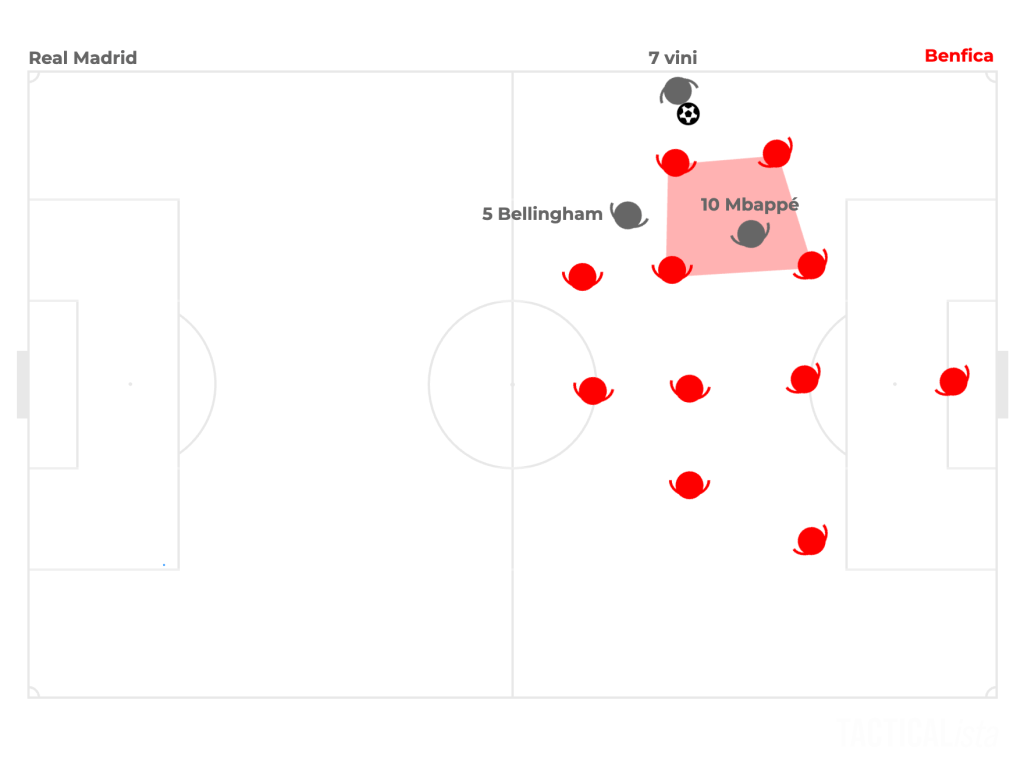
1-2. Group Tactics
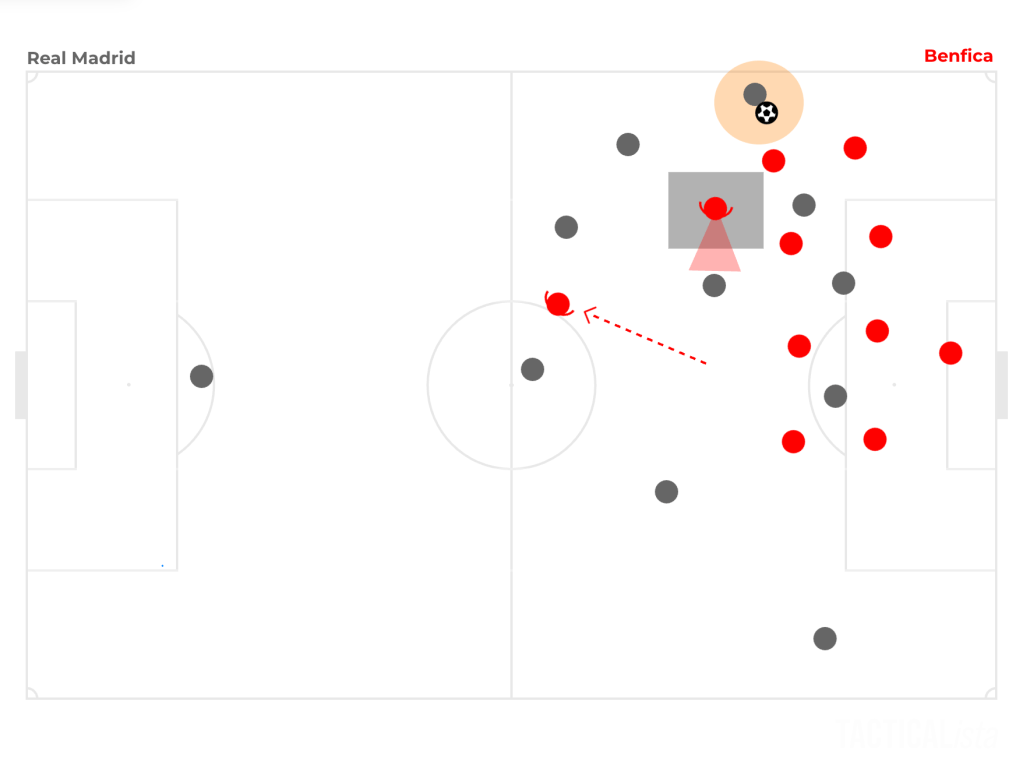
2-1 Role of the Central Forwards
The two forwards prioritized cutting off passing lanes to Real Madrid’s central midfielders, effectively forcing Real to direct their build-up towards the right side of Benfica’s half.
- Right Forward: Maintained a pressing distance from the opposing defensive midfielder while blocking the passing lane to the central midfielder positioned behind.
- Left Forward: Cut off the passing lane to the central midfielder and channeled the opposing center-back’s distribution to a specific side.
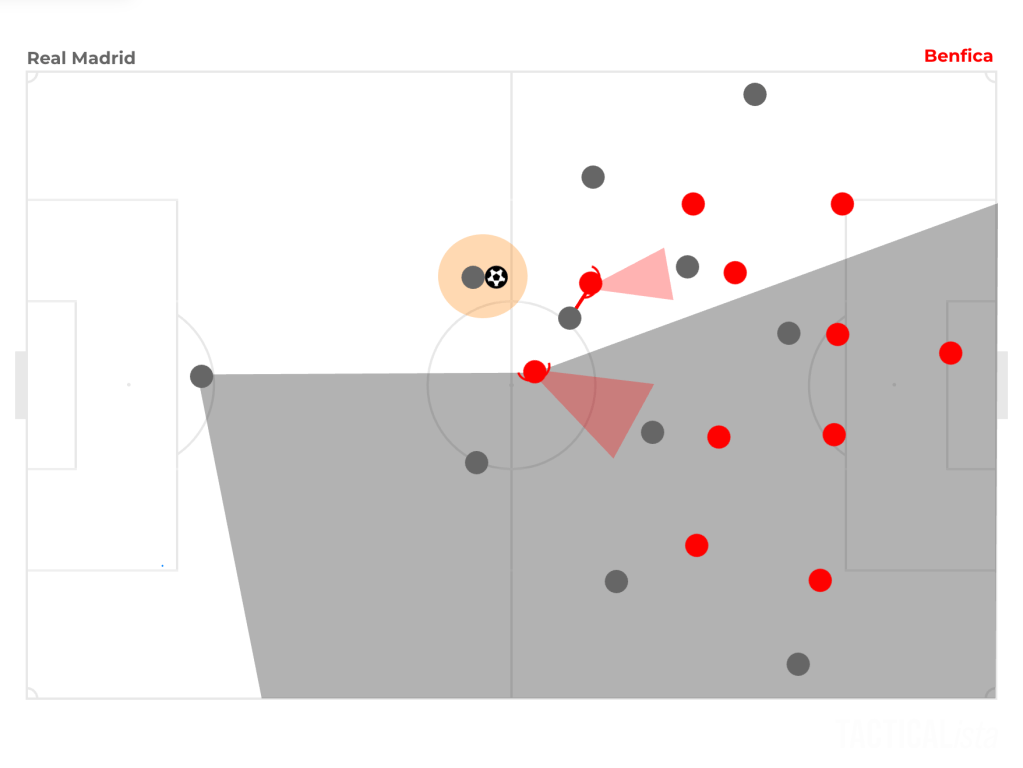
When the opposing center-back distributed the ball out wide, the forwards dropped deeper to once again block the passing lane to the defensive midfielder. Furthermore, they restricted the space for the opponent to play the ball centrally or carry it directly inside, forcing them into inefficient forward plays down the flank or backward passes. This was an essential movement designed to completely neutralize the opponent’s lethal ‘Diagonal Play’.
Diagonal play poses a critical threat to the defending team for the following reasons:
- First is the disruption of the geometric structure and the allowance of central access. When the defensive shape is tilted at a 45-degree angle rather than facing front or sideways, spaces for the opponent to penetrate diagonally are inevitably created. Crucially, this diagonal route naturally forms a pathway toward the center of the pitch, allowing the opponent to swiftly enter the most dangerous central zones directly facing the goal.
- Second is the disadvantage in vision. An attacker receiving the ball while moving diagonally adopts an ‘Open Body’ orientation, allowing them to see both the ball and the field ahead simultaneously. Conversely, the defender’s gaze becomes fixated on the ball, creating a ‘Blind Side’ where they lose track of attackers making runs behind their back.
- Third is the expansibility of the attacking direction. Since the ball is received in central areas rather than along the touchline, the attacker is not limited to a specific direction. They gain the freedom to move in all directions—forward, backward, left, or right.
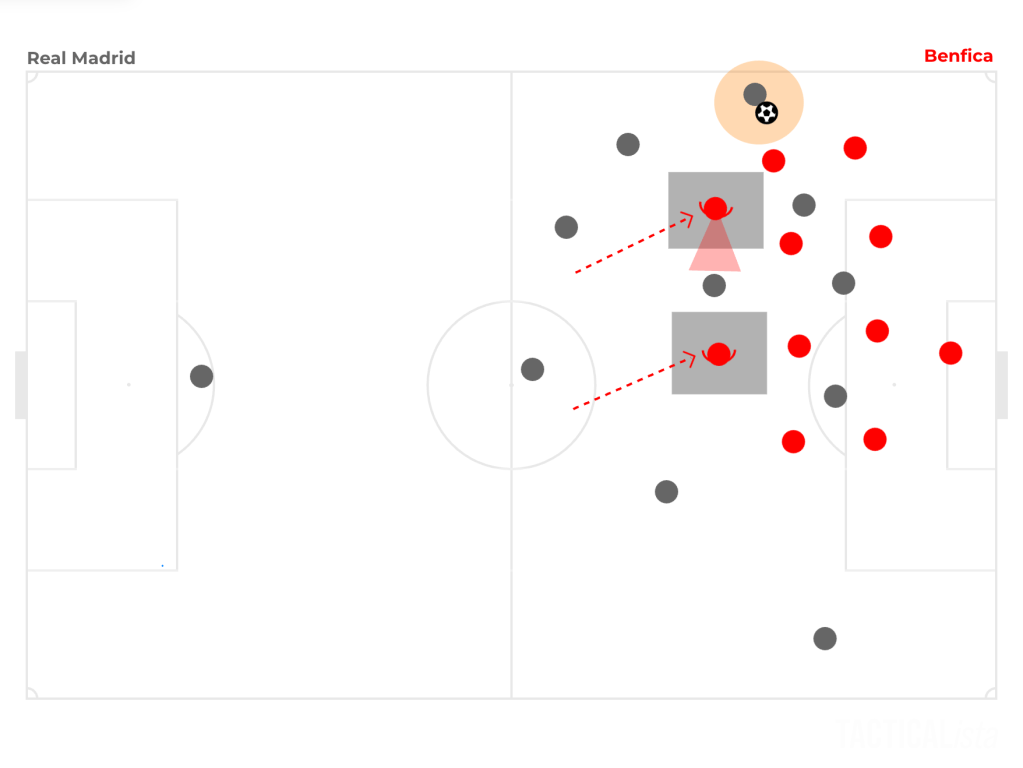
Tactical Shift After Conceding After conceding the opening goal to Mbappé, Benfica aggressively altered the role of the forward positioned on the ball-far side. When Madrid built up play down the flank, the far-side forward took up an attacking position rather than a defensive one. This tactical shift proved crucial in creating the equalizing goal.
2-2. Role of the Central Midfielders
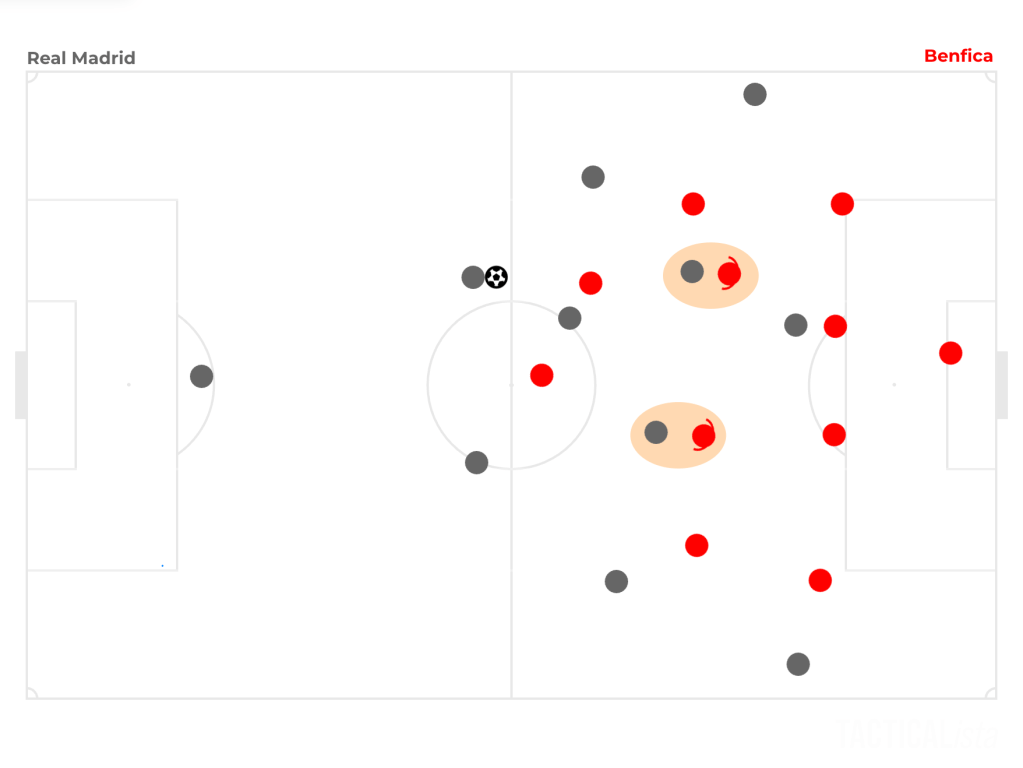
Benfica initiated their defense with the central midfielders marking the opposing midfielders from behind whenever the opponent held the ball in central areas.
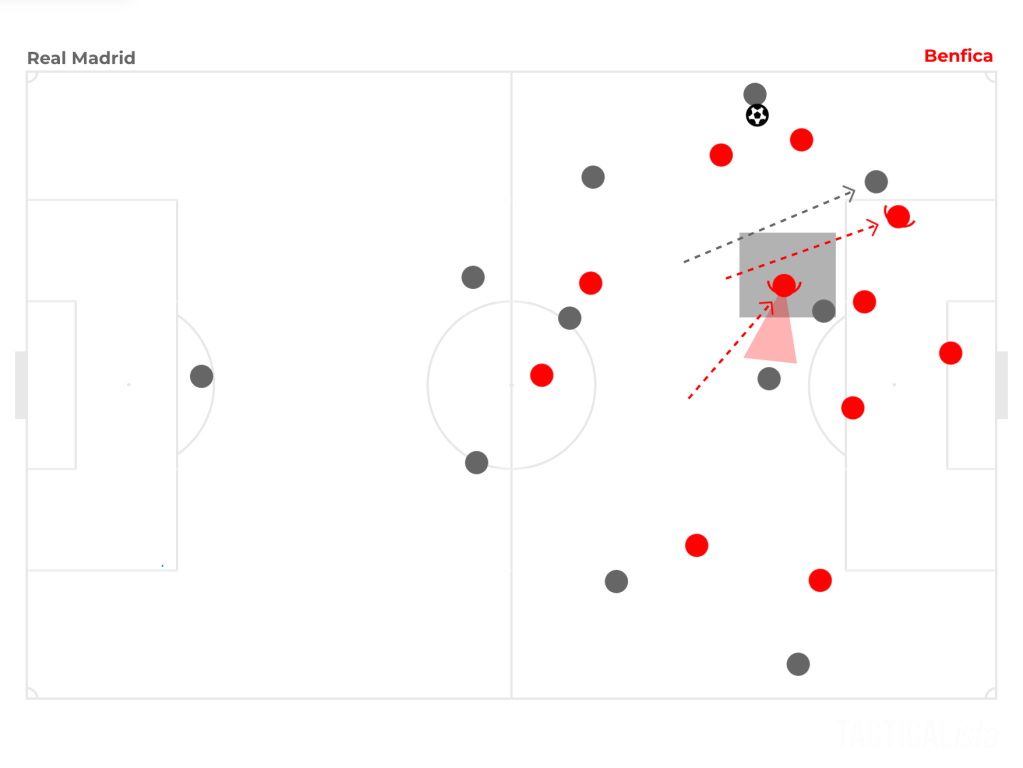
- Controlling Penetrative Runs: On the right side of Benfica’s half, Jude Bellingham frequently made penetrative runs into the space between the fullback and the center-back (the half-space). In response, Benfica’s central midfielder positioned himself behind Bellingham, prioritizing the defense against these runs.
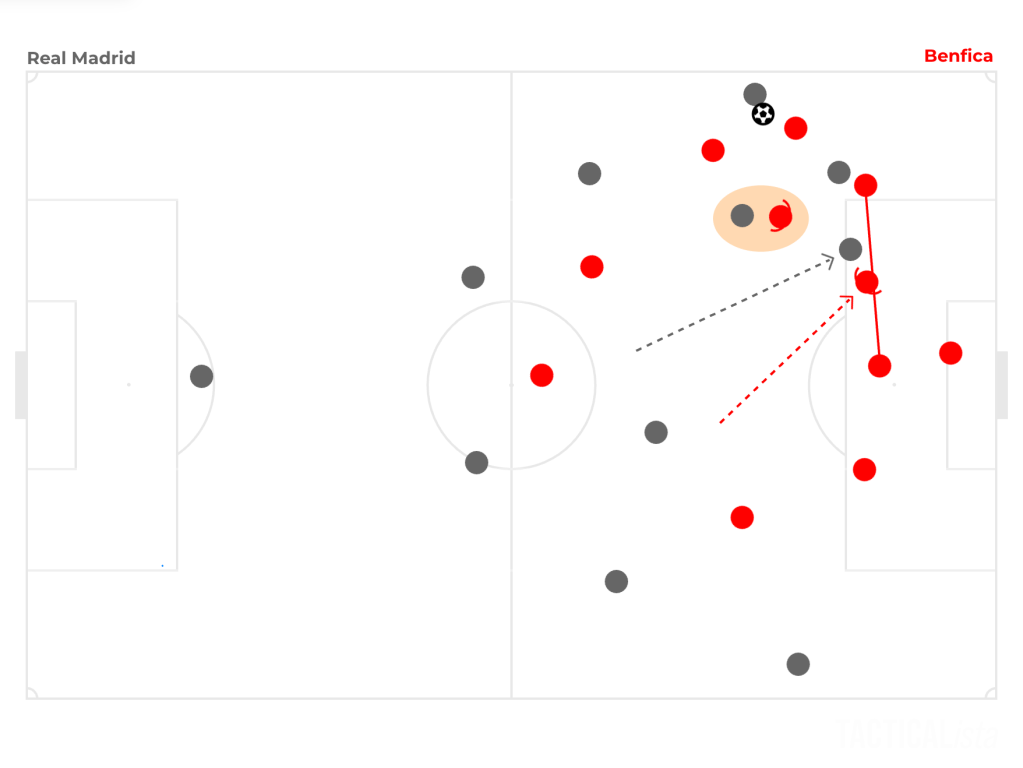
- Fluid Space Covering: When a central midfielder tracks a penetrating runner deep into the defensive third, the central space they vacate is inevitably left exposed. The other central midfielder, positioned on the far side, immediately shifted over to cover this newly created void. Notably, during this covering action, he did not merely occupy the space but demonstrated intelligent movement by simultaneously cutting off the passing lane to his original mark.
- Neutralizing Third-Man Runs: Their response to the opponent’s third-man runs was equally resolute. The ball-near midfielder focused his defensive efforts around the ball, while the ball-far midfielder tenaciously tracked and obstructed the penetrating runner, completely eliminating potential tactical variables that could lead to a goal.
2-3. Roles of the Center-Backs and the Goalkeeper
As mentioned earlier, Madrid primarily targeted the right side of Benfica’s half. Consequently, Benfica’s right center-back was tasked with the heavy burden of defending both the space and the man simultaneously.
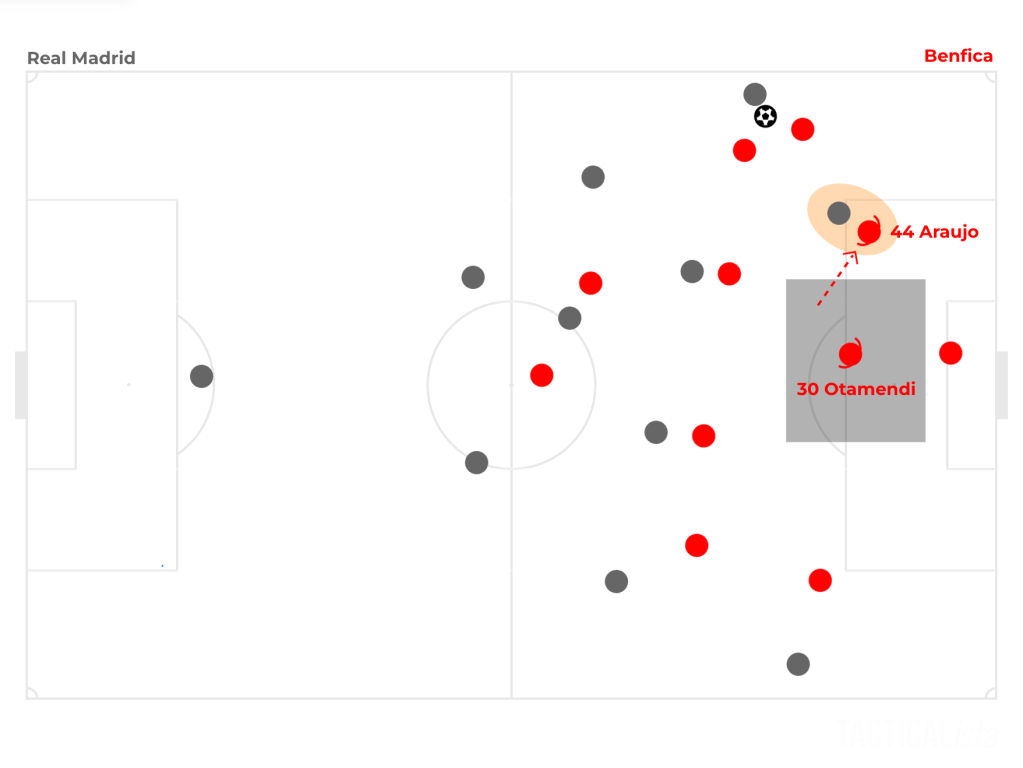
- Strategic Center-Back Partnership: Benfica intentionally deployed a young, pacy defender in that right-sided role. While the right center-back’s (Araújo) role constantly shifted depending on the situation, the left center-back (Otamendi) firmly anchored the space in front of the goal and orchestrated the entire defensive line. The highly mobile Araújo covered immense ground to neutralize right-sided attacks, while the experienced Otamendi provided structural organization.
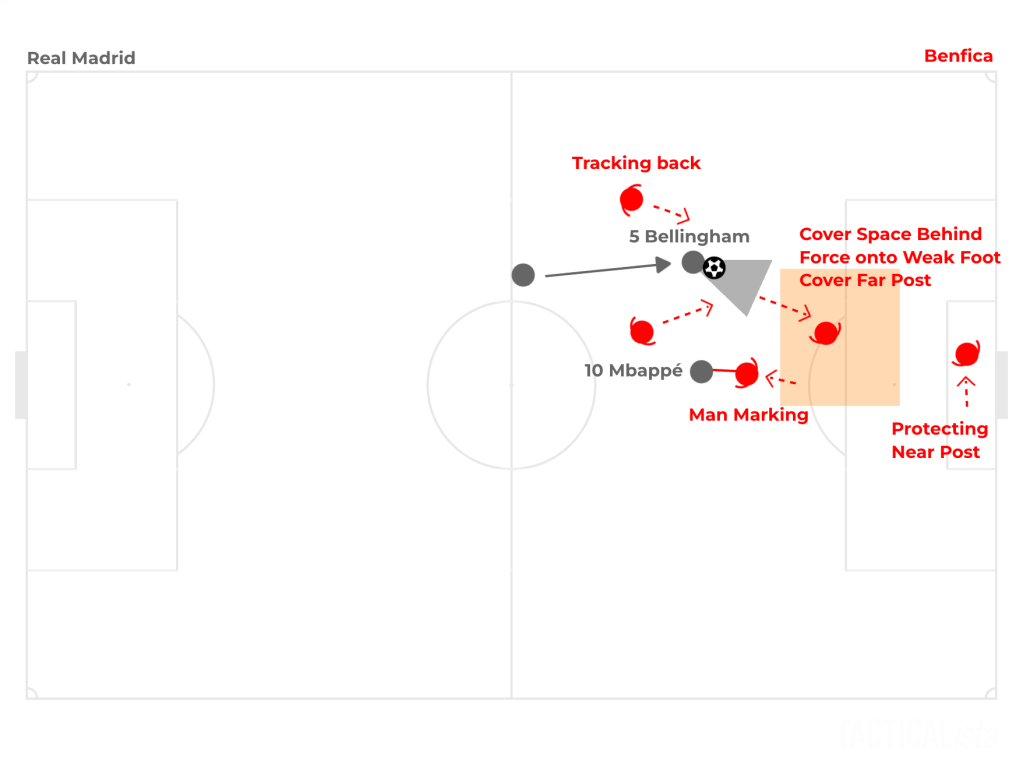
- Denying the Turn: The primary objective was to prevent the opponent from turning and facing forward when receiving the ball in front of the defensive line. However, when an attacker did manage to receive the ball between the lines and face forward, the division of roles within Benfica’s defense was crystal clear:
- Forcing the Play & Sealing the Angles: Through these coordinated movements, they severely restricted the ball carrier’s link-up options, forcing him into a forward dribble. They then tactically channeled the attacker onto his weaker left foot, effectively reducing his shooting accuracy and completely cutting off the shooting angle to the far post.
- Final Execution: During this phase, the defending center-back maintained a blockable distance and aggressively engaged the moment the attacker attempted a shot or moved the ball into the forced direction. In this critical moment, responsibilities were perfectly divided: the goalkeeper locked down the near post, while the center-back concentrated entirely on defending the far post.
2-4. Flank Defensive Tactics
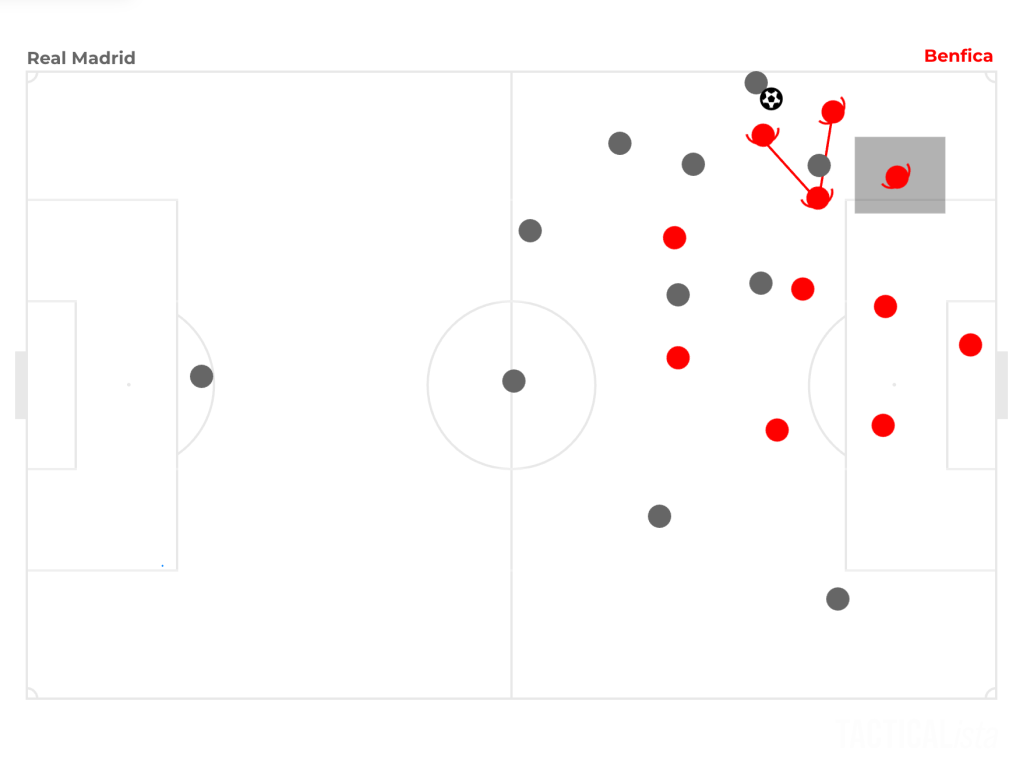
Fundamentally, whenever Vinícius Júnior or Kylian Mbappé received the ball on the flank, Benfica’s winger and full-back collaborated to form a tight double team (2v1).
- The Channel (Space Between): The central midfielder covered the gap for any inside drives between the winger and the full-back.
- The Forward Space (Space in Behind): The center-back stepped up to block the forward space for for them to drive into.
Together, these four players maintained a diamond-shaped defensive block, making flank dribble penetrations incredibly difficult. In fact, Vinícius and Mbappé were completely stifled in these zones, committing frequent turnovers.
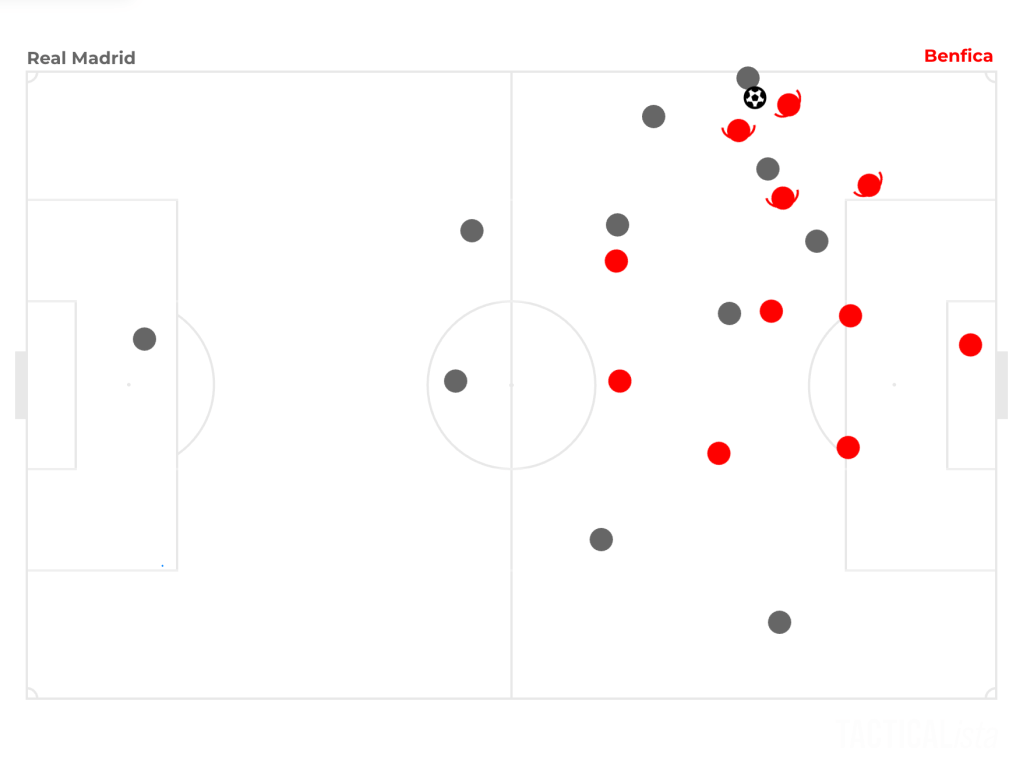
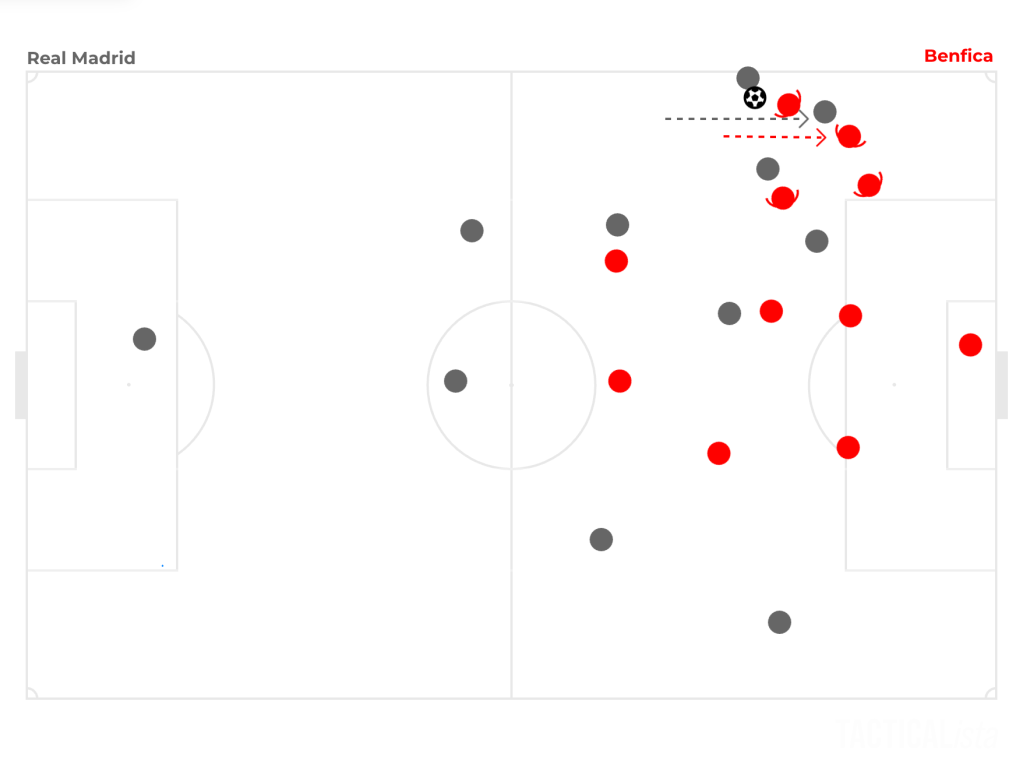
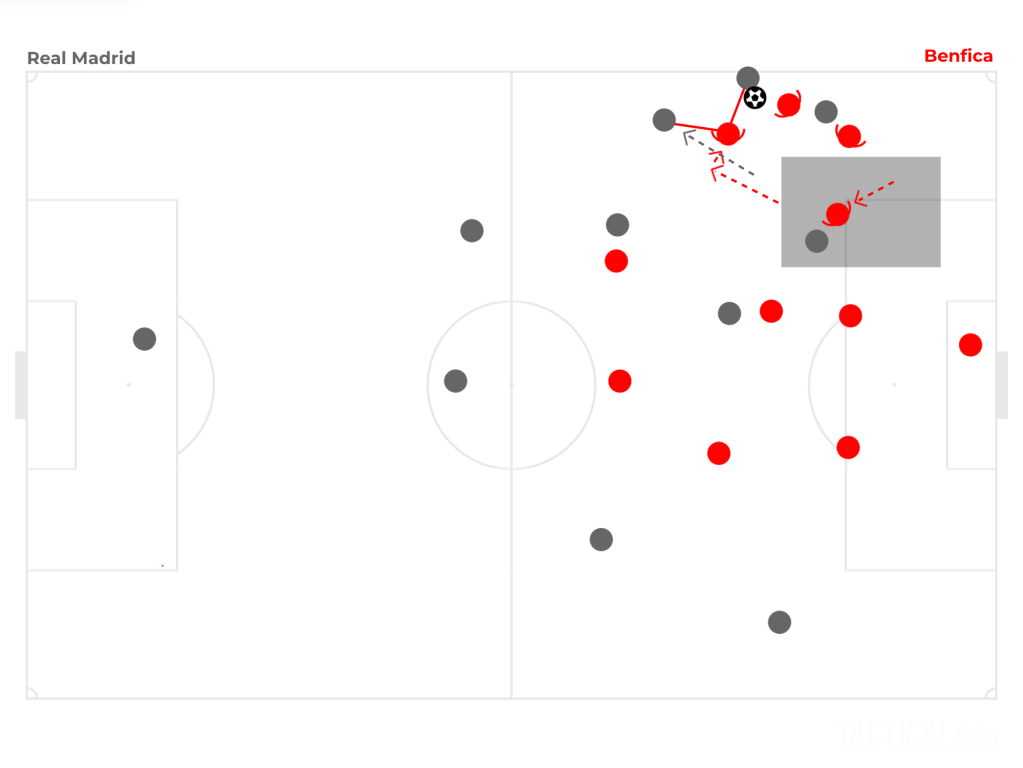
Neutralizing Mbappé’s Diagonal Threat: Mbappé typically enjoys peeling off into the space between the winger and the full-back to receive the ball. He is exceptionally lethal when receiving the ball on a diagonal to the goal and driving forward. Manager José Mourinho anticipated this perfectly. He instructed his central midfielder to step out immediately the moment Mbappé received the ball, denying him the forward view. The central midfielder would seamlessly hand over his original mark (Bellingham) to the full-back or center-back before rapidly pressing Mbappé. Consequently, Mbappé lost possession multiple times in these exact situations.
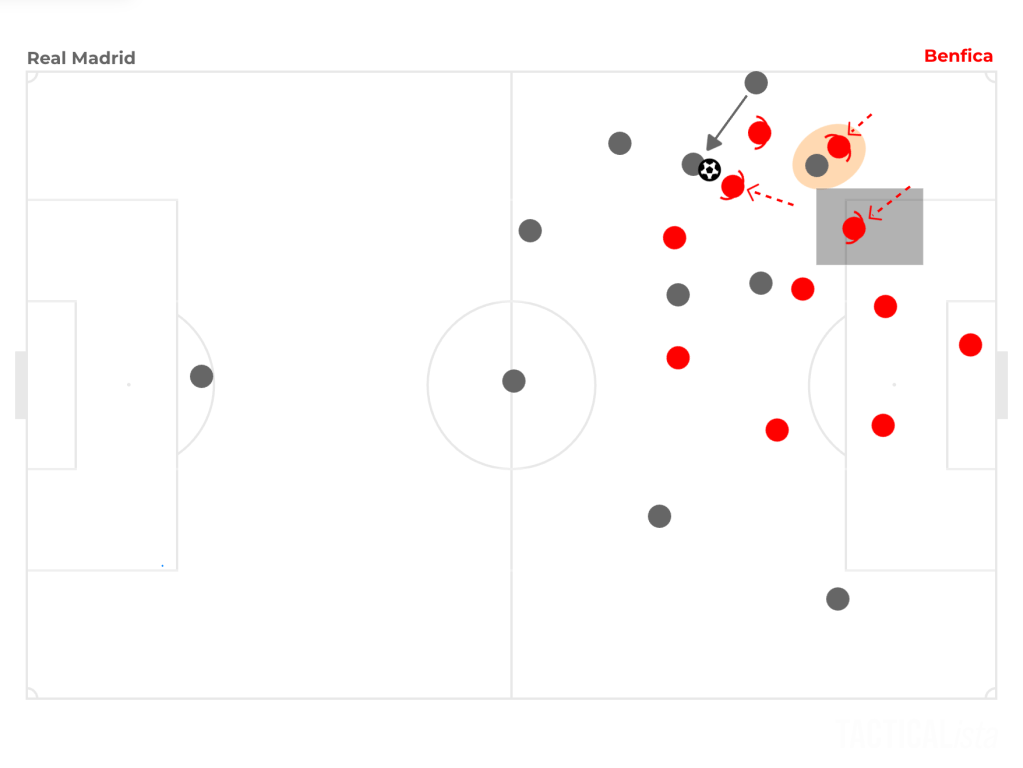
Responding to Madrid’s Overloads: When this primary attack failed, Madrid attempted to create space by pushing their full-backs forward. They aimed to achieve numerical parity by committing more bodies forward and generating space through dynamic movement. Benfica responded to this with strict man-to-man marking:
- Full-back’s penetrating run → Tracked by the winger.
- Movement into vacated space → Tracked by the central midfielder.
- Space vacated by the central midfielder → Covered by the center-back.
- Note: This sequence inevitably created a pocket of space for Vinícius to cut inside centrally, but this was once again covered by the central midfielder making a swift recovery run.
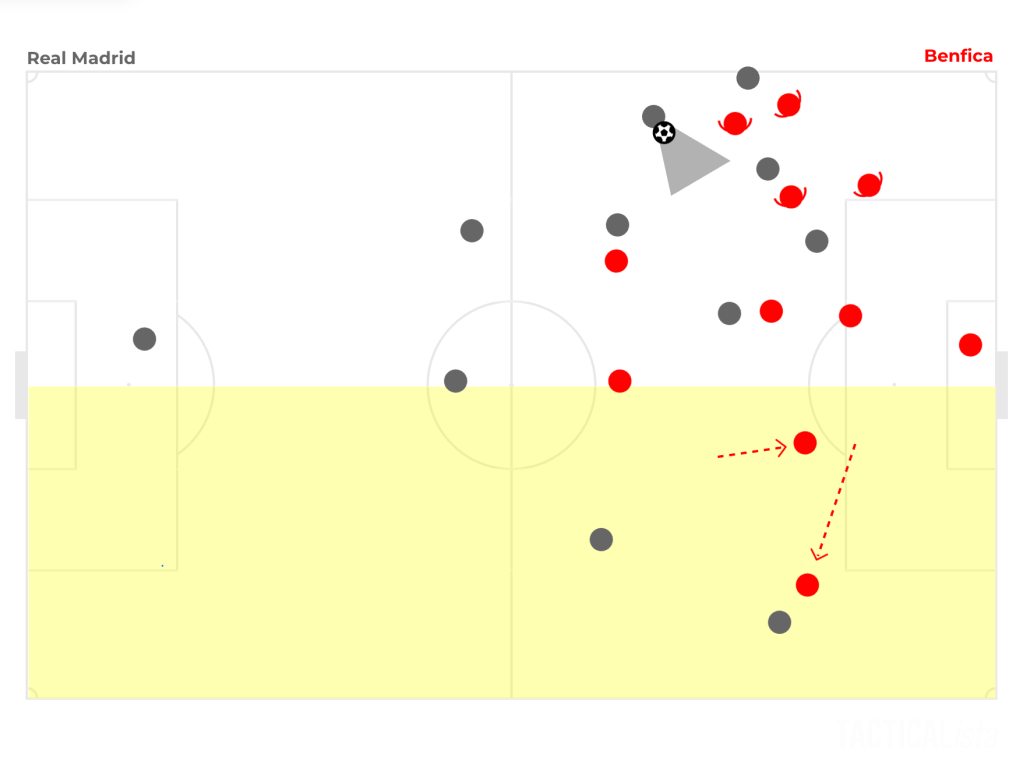
Defending the Switch of Play: Finally, regarding the switch of play: Whenever Madrid secured the vision and space to execute a long diagonal switch to the opposite flank, Benfica’s left full-back would vacate his compact positioning and aggressively step out to press Madrid’s right winger. This was because Madrid’s attackers possess such elite technical ability that allowing them to turn and face forward would highly likely result in the defense collapsing in a 1v1 isolation. The space vacated by the stepping full-back was subsequently covered by the winger or central midfielder, thereby neutralizing even the chances created through diagonal switches.
2-5. Defensive Transition
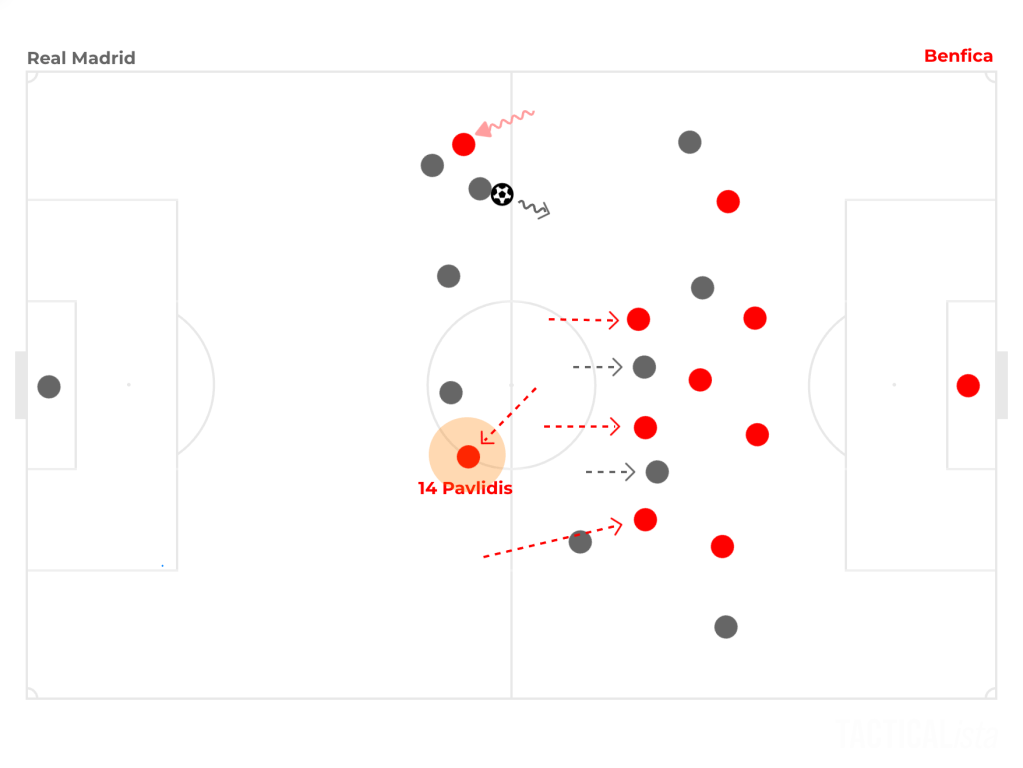
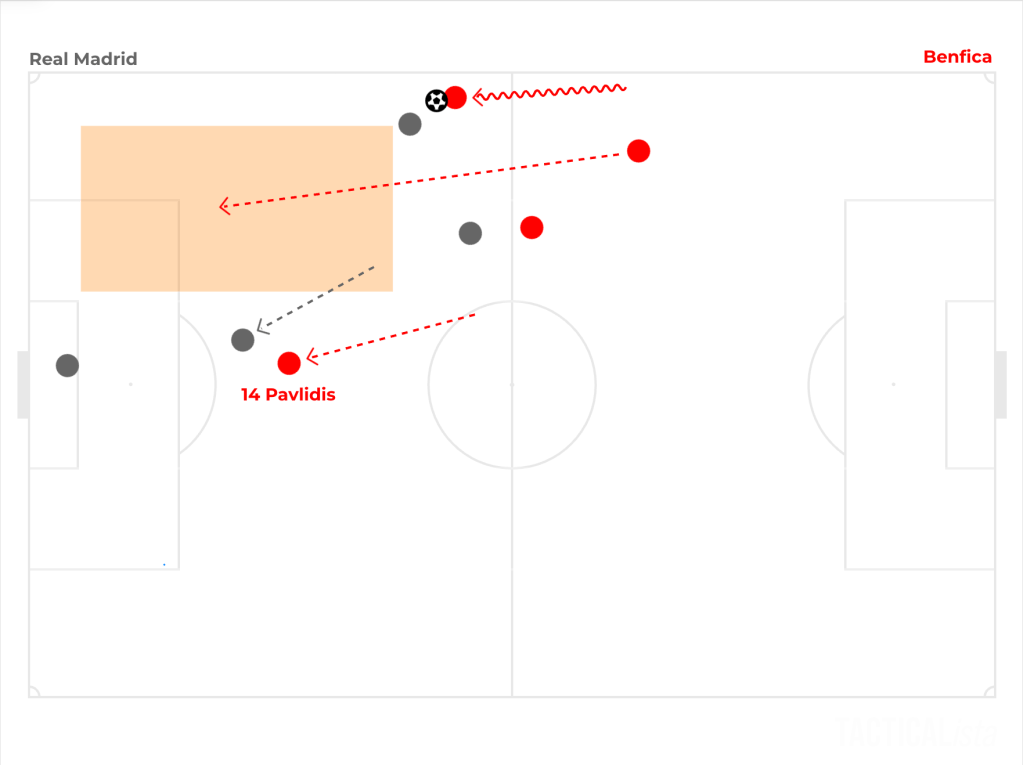
During defensive transitions, the central striker, Pavlidis (No. 14), intentionally refrained from dropping deep into the defensive third. This was a calculated tactical decision to keep him higher up the pitch as an immediate forward outlet, enabling a rapid counter-attack the moment the team successfully regained possession.
1-3. Individual Tactics
3-1. 1v1 Defensive Tactics Against Vinícius Júnior
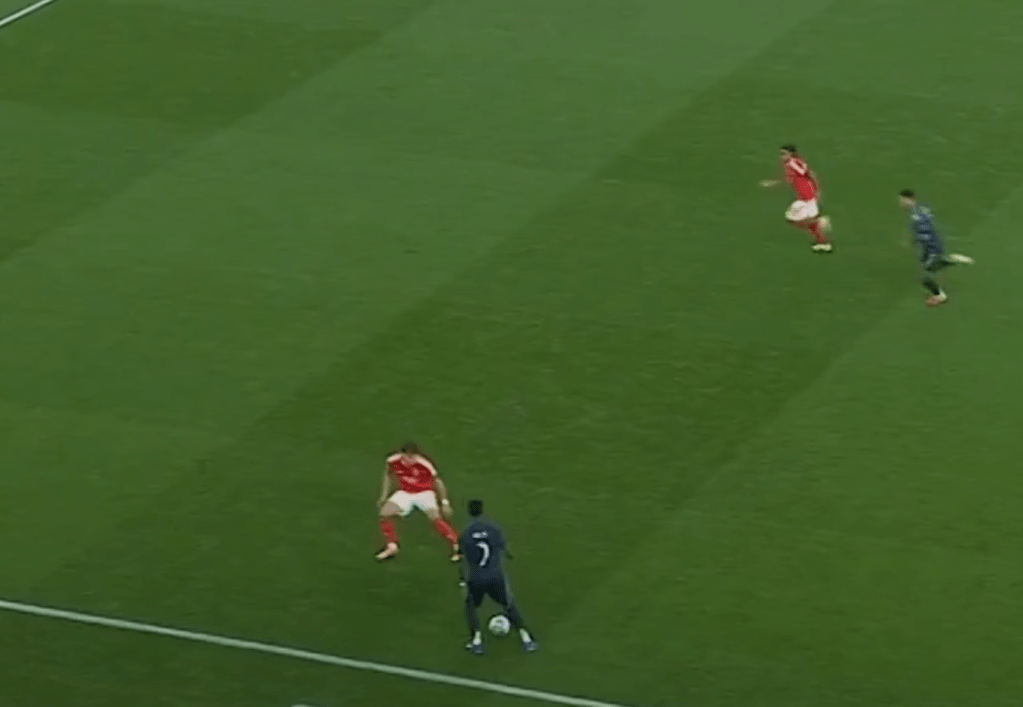
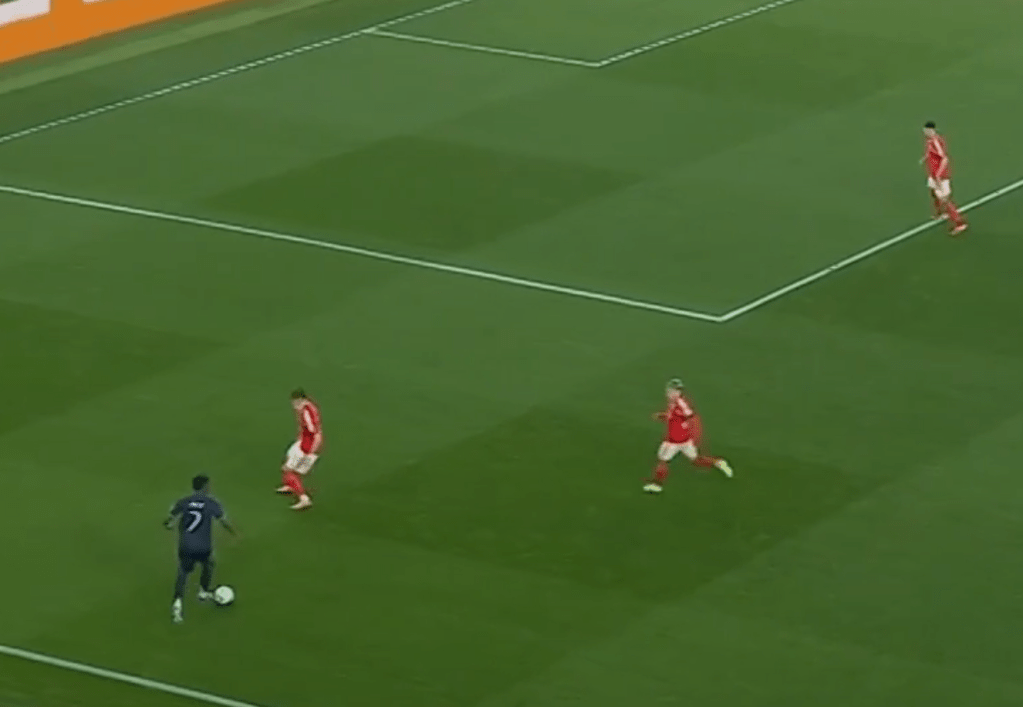
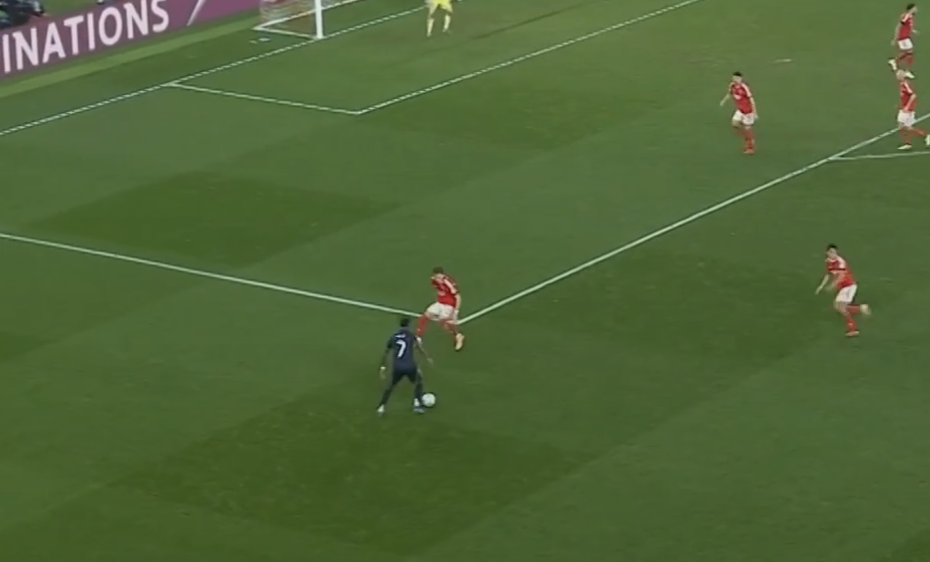
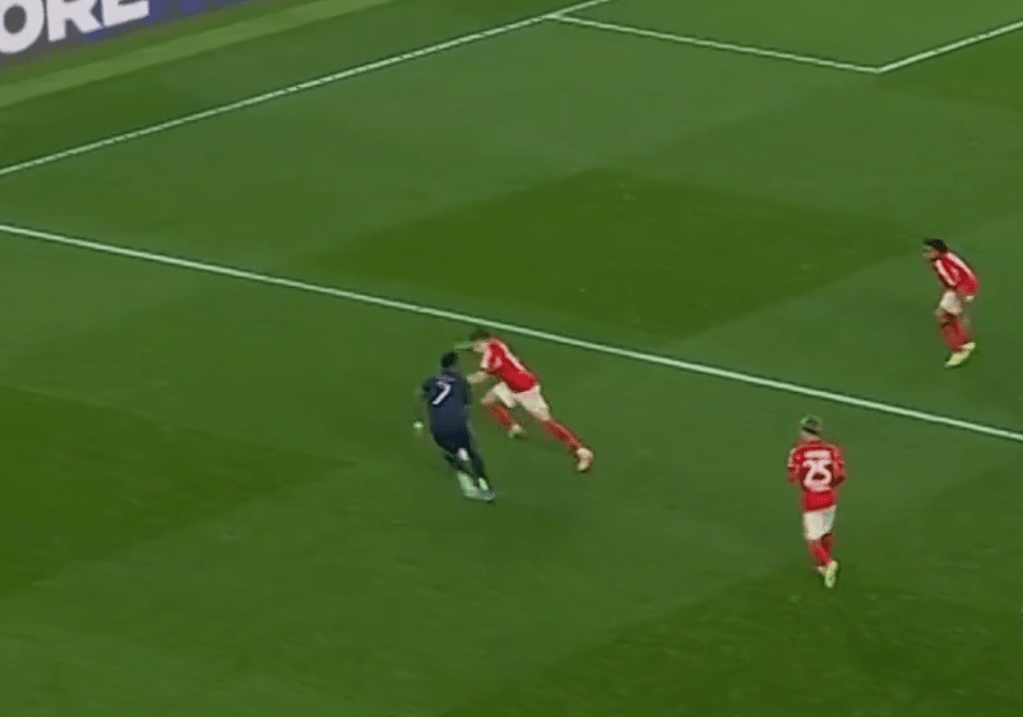
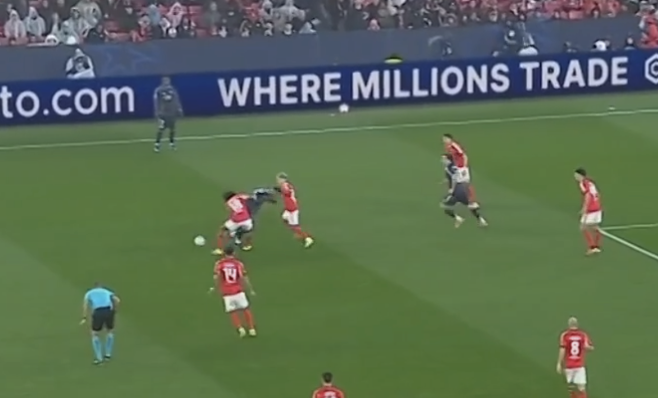
Benfica’s Amar Dedić (No. 17) adopted a defensive body shape that seemingly opened up the flank, intentionally inviting Vinícius to take the ball down the outside.
- Biomechanical Advantage: Positioning himself slightly diagonally behind the winger with his weight loaded on his right leg, Dedić reacted faster than Vinícius the moment the ball was pushed wide, instantly claiming the advantageous position.
- Physical Engagement: Furthermore, he actively used his arms to physically obstruct Vinícius from cutting inside, effectively steering the attacker’s momentum.
- Tactical Result: Consequently, Vinícius was completely isolated on the touchline and forced onto his weaker left foot, rendering him unable to create any meaningful impact throughout the entire match.
3-2. Defensive Strategy Against Kylian Mbappé
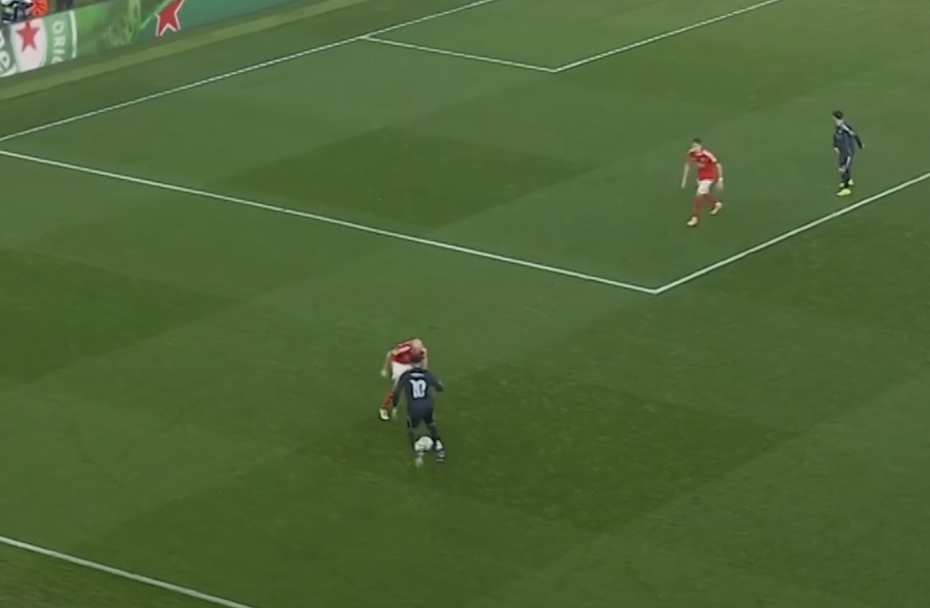
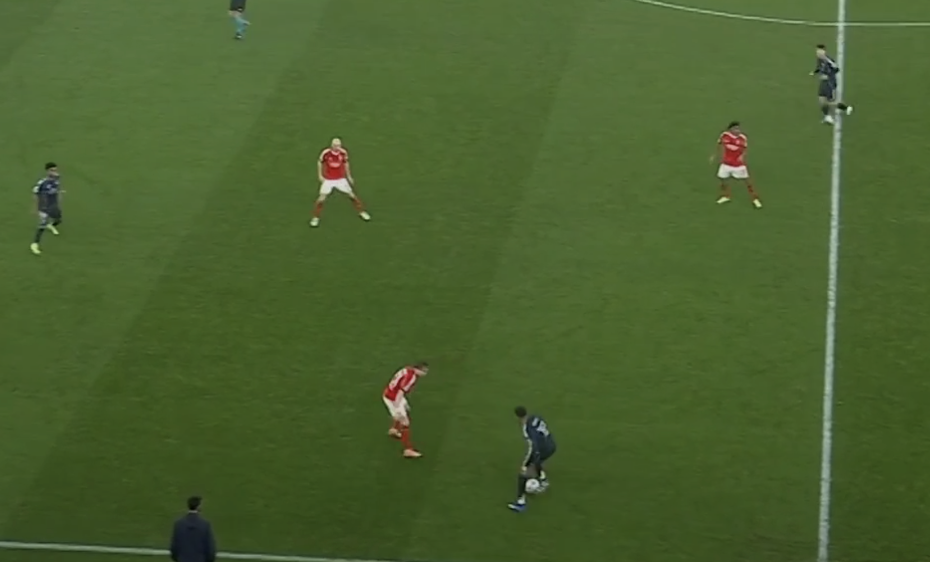
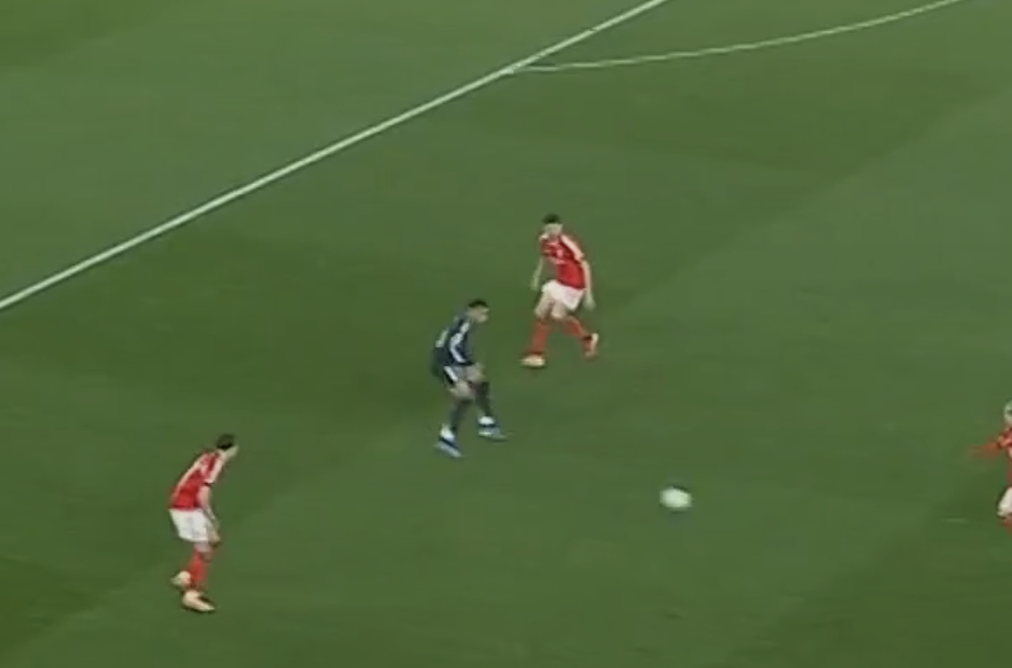
- Anticipating the Turn (Central Areas): When Mbappé operated centrally, defenders prioritized preparing for his subsequent actions rather than committing to tight, aggressive pressure. This cautious approach was adopted because committing too early often left defenders caught wrong-footed by his explosive turns, instantly conceding dangerous shooting spaces. However, they selectively applied intense pressure if the pass was slow or if the defender’s reaction time allowed for it.
- Channeling Inside (Body Shape): Against Mbappé, Benfica’s defenders adopted the exact opposite body shape compared to their strategy against Vinícius. They intentionally closed off the flank and opened up the center, inviting him to drive inside.
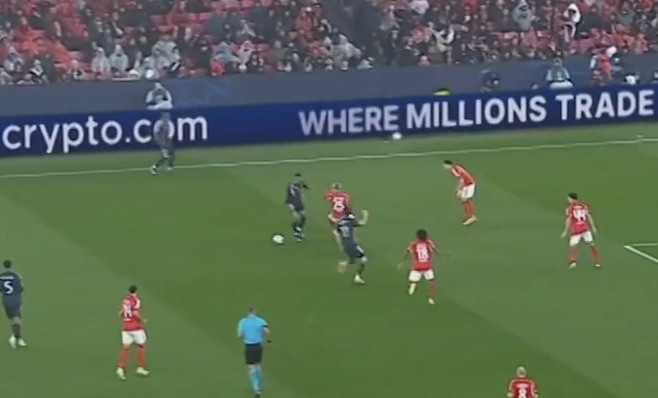
- Collective Trapping: Rather than relying on isolated 1v1 man-marking, Benfica utilized a highly orchestrated, collective defensive scheme against him. By shutting down the wide route and funneling him into the crowded central area, a centrally positioned teammate would immediately step up to apply a collaborative double-team and regain possession.
- Tactical Result: Throughout the match, while Mbappé’s reactions to the primary defender were sharp, he consistently struggled to process and react to the rapid convergence of the second defender, leading to multiple turnovers.
2. In Possession
2-1. Team Tactics
Upon transitioning to attack, Benfica focused heavily on rapidly exploiting the space behind Madrid’s backline. During the build-up phase, rather than progressing the ball through the congested center, the wingers intentionally tucked inside to vacate the flanks. The team then swiftly utilized these newly created wide channels.
- Maximizing Squad Profile: This strategic approach perfectly maximized the strengths of Benfica’s personnel. Lacking traditional, creative central playmakers but possessing highly direct and pacy wingers and full-backs, they opted to manufacture space out wide and attack down the flanks rather than forcing plays through the middle.
- Exploiting Madrid’s Weakness: Furthermore, they deliberately targeted Madrid’s wide areas. They were fully aware that Madrid’s wingers carry a heavy offensive burden and often neglect their defensive tracking back, which inevitably left Madrid numerically disadvantaged on the flanks.
2-2. Group Tactics
2-1. Attacking Transition
To fully grasp Benfica’s attacking transition, it is essential to first understand Madrid’s offensive system.
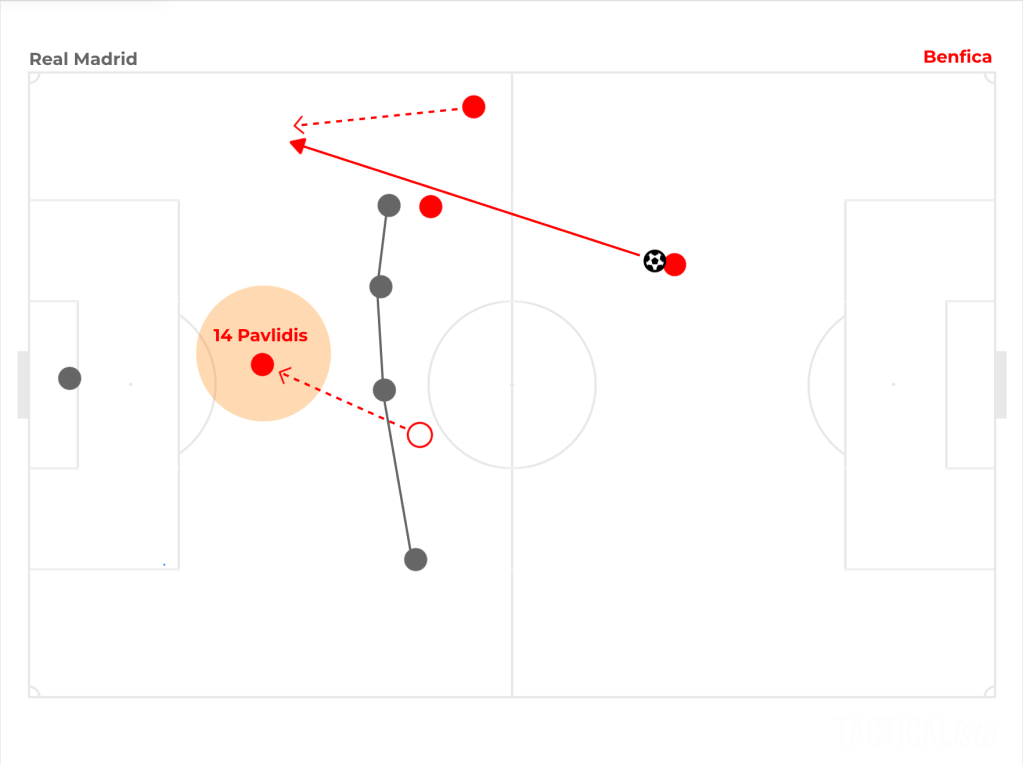
Madrid’s Asymmetrical Overload: Madrid primarily attacked down Benfica’s right flank, deliberately deploying Vinícius, Mbappé, and Bellingham in that zone to maximize their destructive potential in tight spaces. Because of the heavy offensive focus of this trio, the full-back behind them, Carreras, was forced to push high up the pitch to provide cover or generate space. Consequently, the near-side center-back had to step out wide to cover Carreras’s vacated space, which ultimately stretched the distance between Madrid’s center-backs.
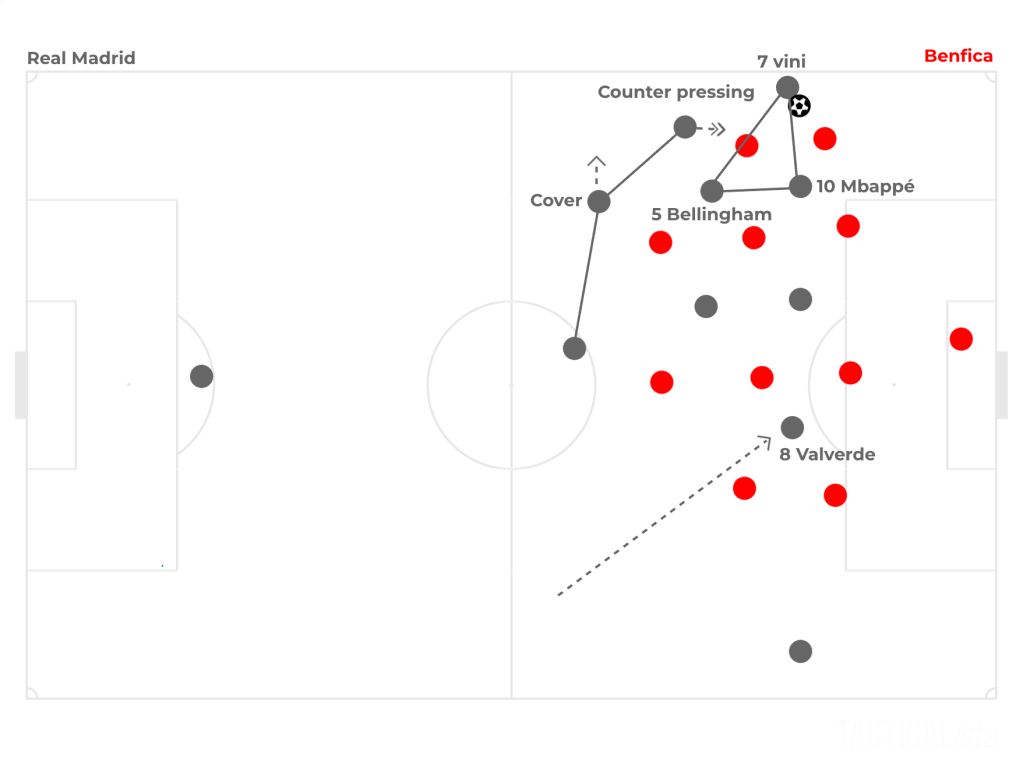
Beating the Counter-Press: The exact moment Benfica won the ball in that congested right-sided area, Carreras immediately attempted a counter-press, but his isolated effort was insufficient. The center-back, who had stepped out to cover the space behind Carreras, found himself caught in ‘no-man’s land’—neither effectively pressing the ball nor protecting the space. (Dropping deep would allow the opponent to drive forward, while stepping up to press would leave only a single defender at the back.)
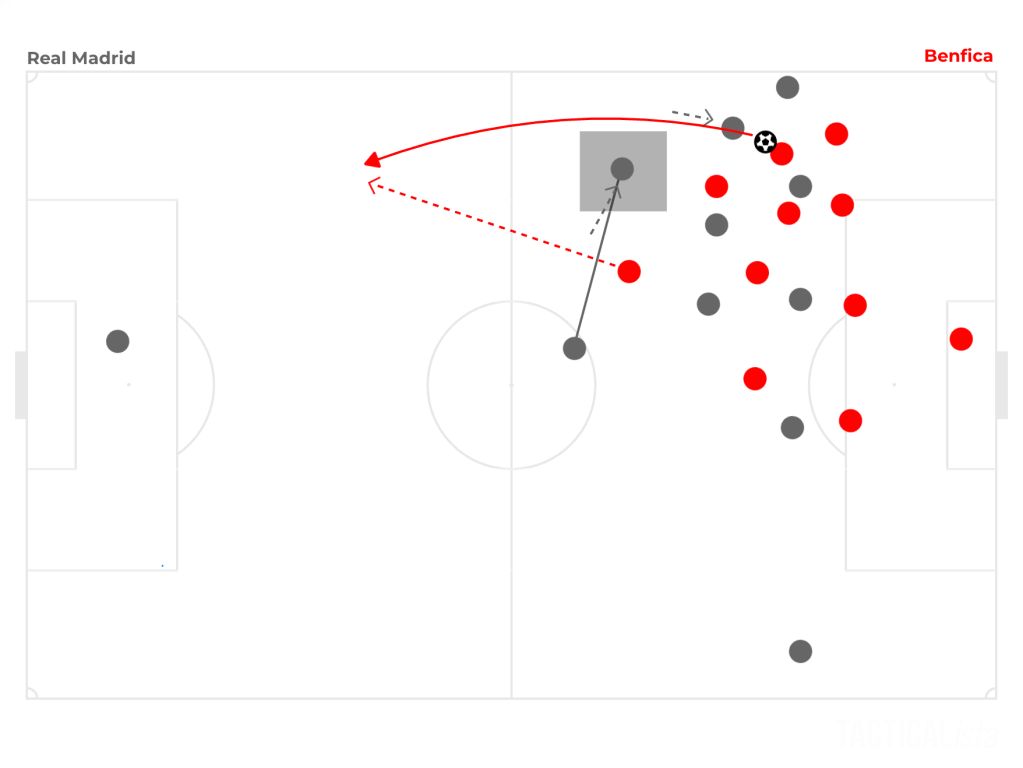
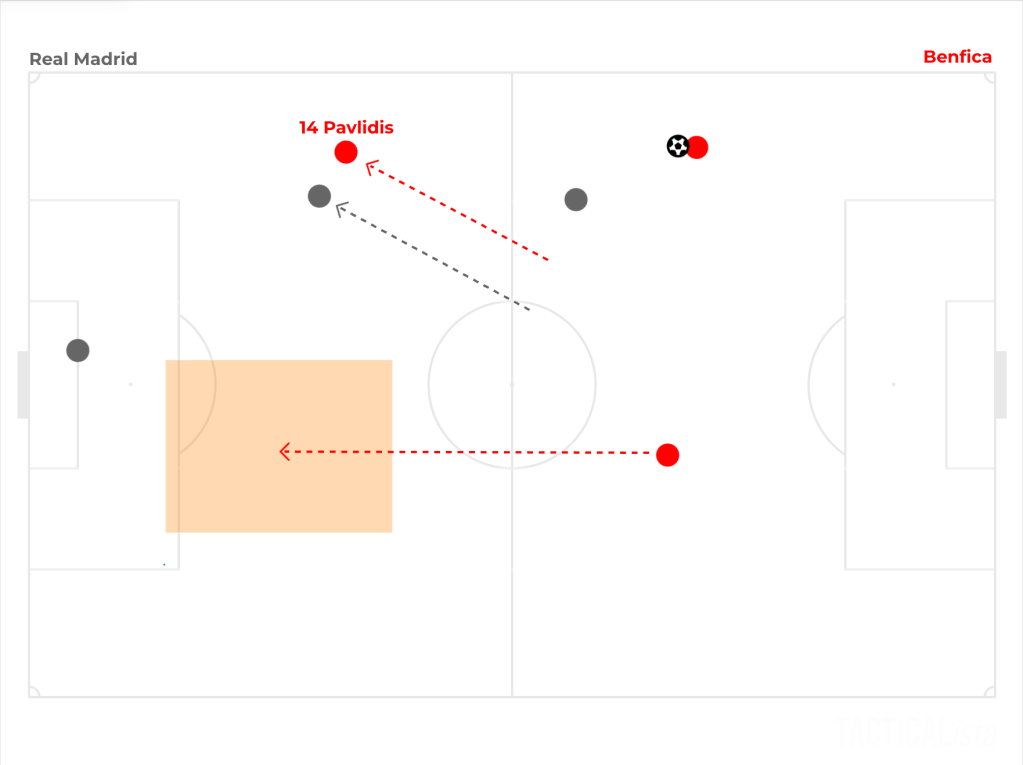
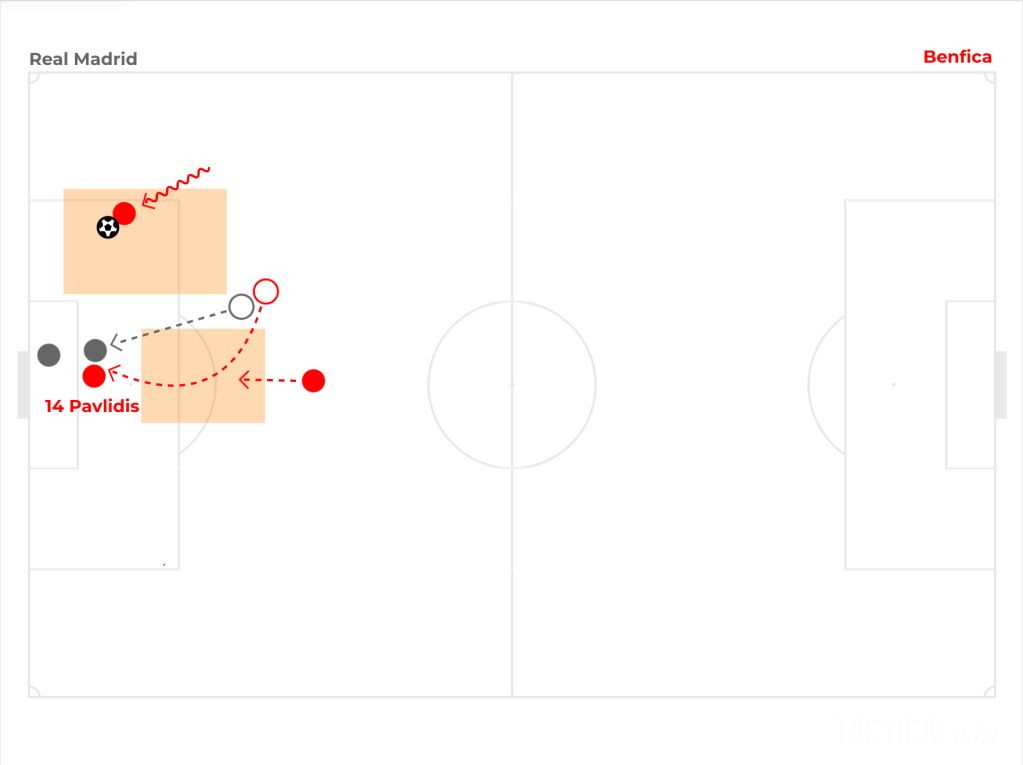
Exploiting the Structural Gap: Seizing this structural vulnerability, Benfica instantly played the ball into the space behind the center-backs, triggering a forward run from their central striker. Madrid’s far-side center-back, Asensio, was drawn out as he had no choice but to track the ball-carrying striker, inevitably vacating his own position. Benfica’s left winger then rapidly penetrated into this newly exposed gap.
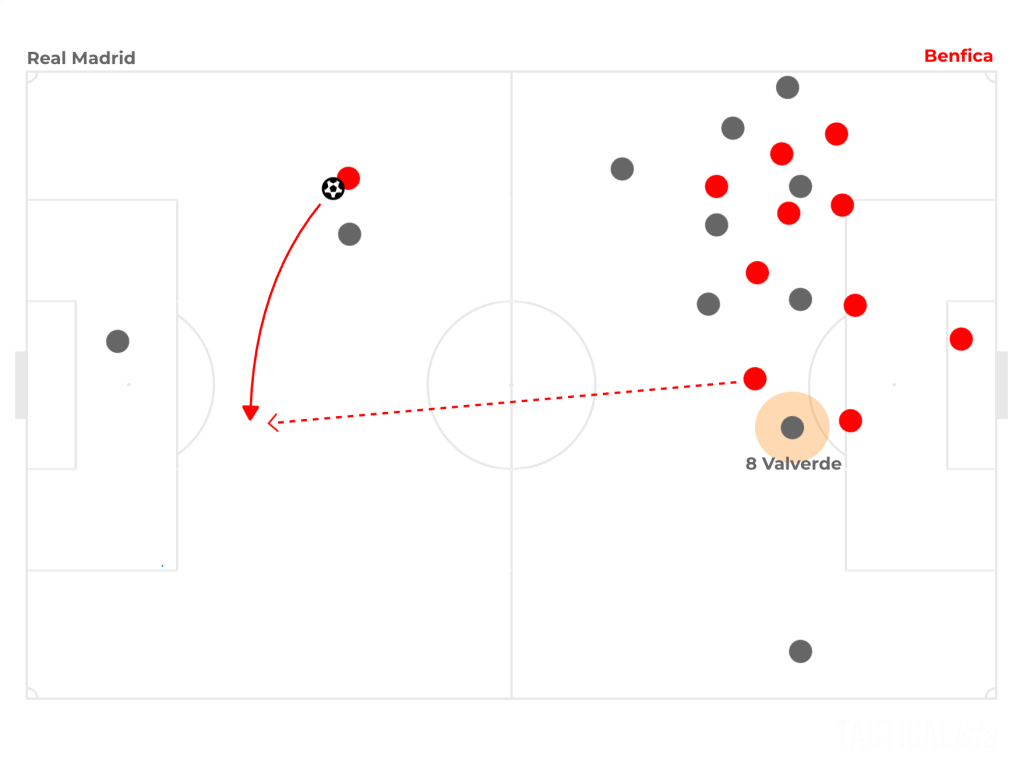
Tactical Breakdown & xG: At this critical juncture, Madrid suffered another tactical breakdown. Valverde was positioned far too high up the pitch, and Mastantuono displayed a distinct lack of desire to track back defensively. In fact, Benfica’s equalizing goal materialized from this exact pattern, and they consistently replicated this sequence throughout the match, generating a remarkably high Expected Goals (xG) figure.
2-2. Build up Phase
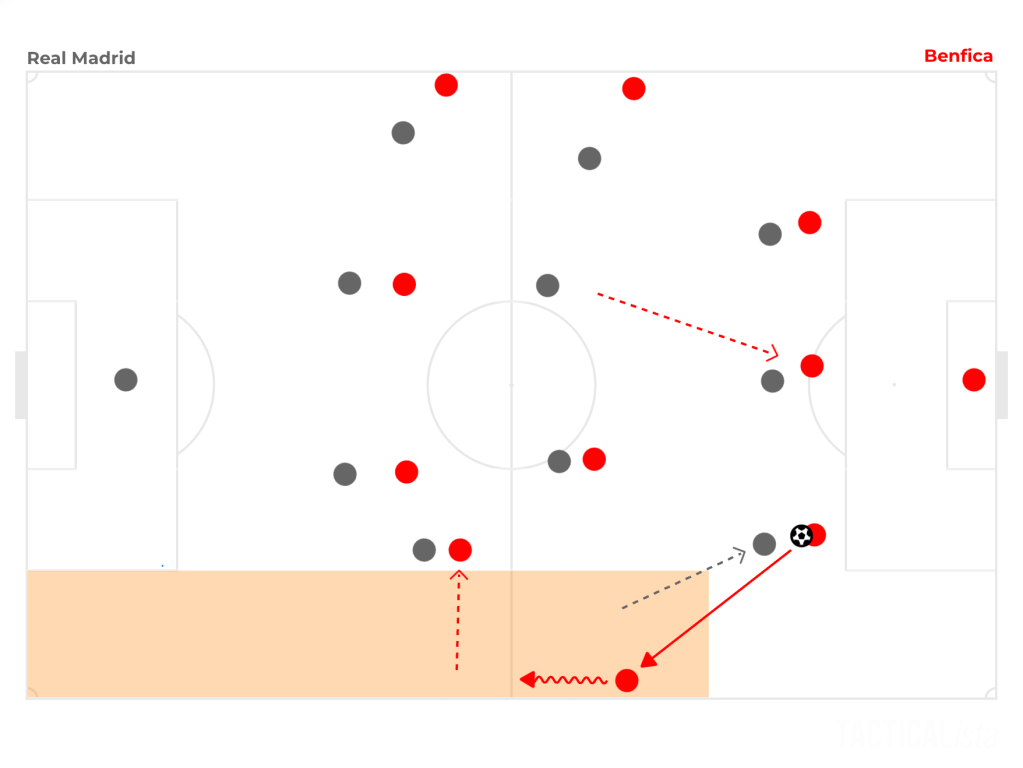
Initial Setup & Breaking the Man-Marking: In the initial stages, both teams matched up symmetrically, with Madrid attempting a strict man-to-man marking system against Benfica’s front four. However, Benfica effectively fractured this scheme through the inward movement of their wingers. As the wingers tucked inside, they dragged Madrid’s full-backs centrally, allowing Benfica to utilize the newly vacated space on the flanks in a variety of ways.
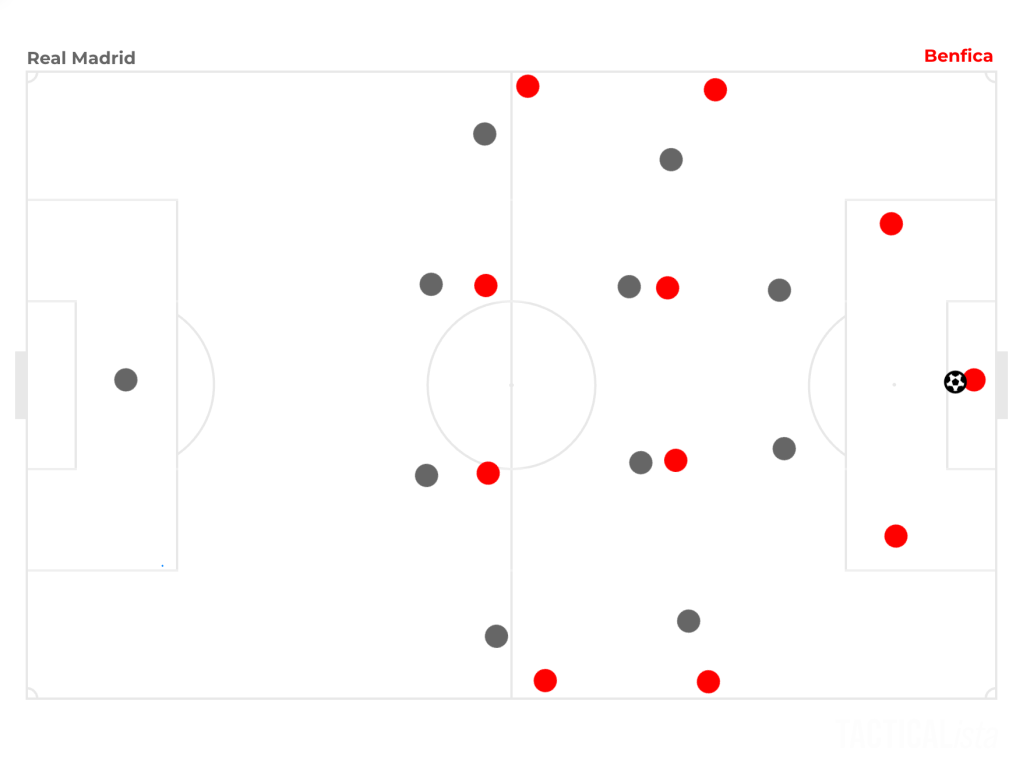
Tactical Flexibility (Shifting Centrally): Once Madrid read and adjusted to this wide pattern, Benfica dynamically altered their approach. They shifted their focus to drawing the center-backs out of position to exploit the central space. Although this didn’t culminate in highly threatening shots, it was an impressive display of their tactical flexibility.
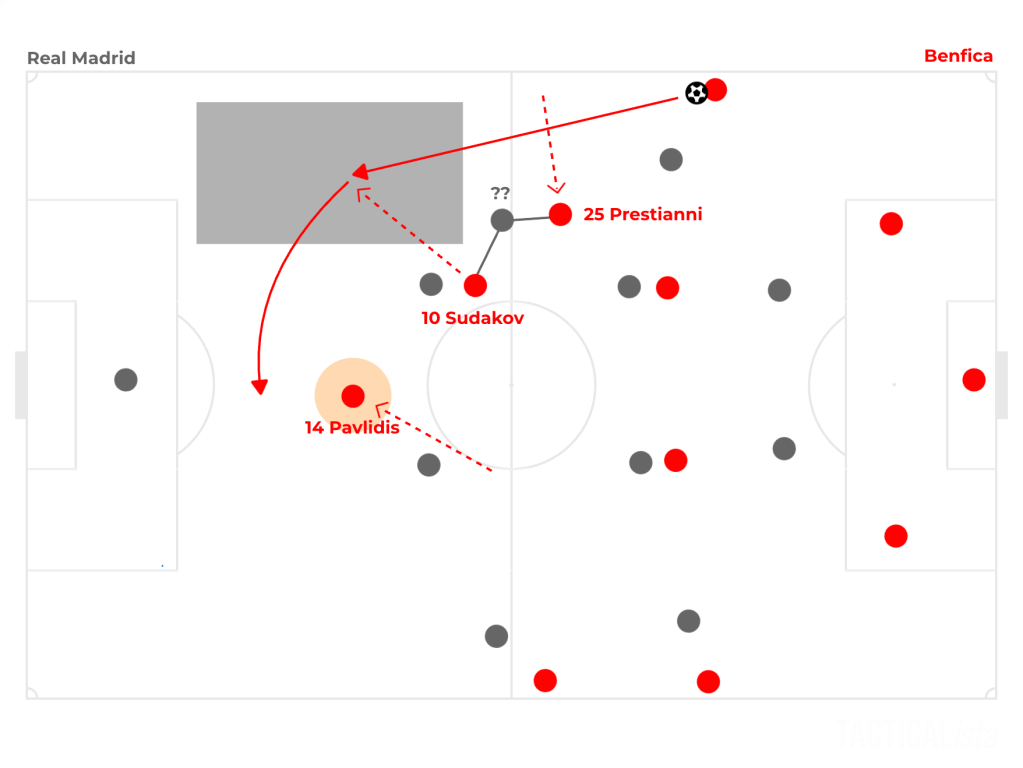
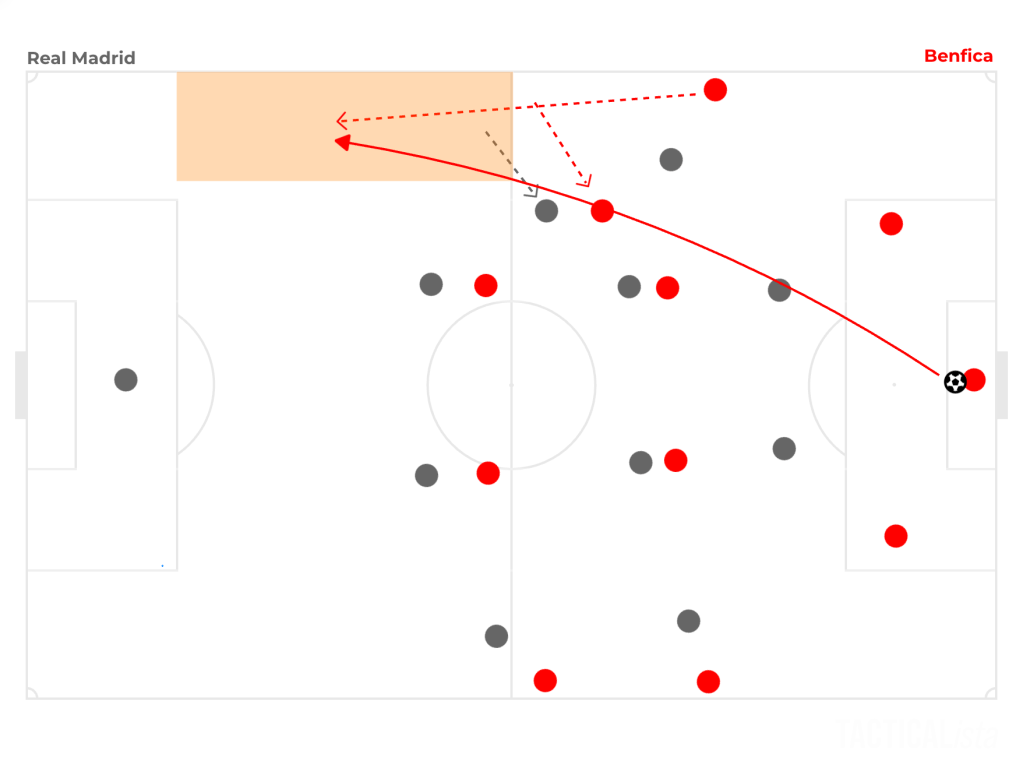
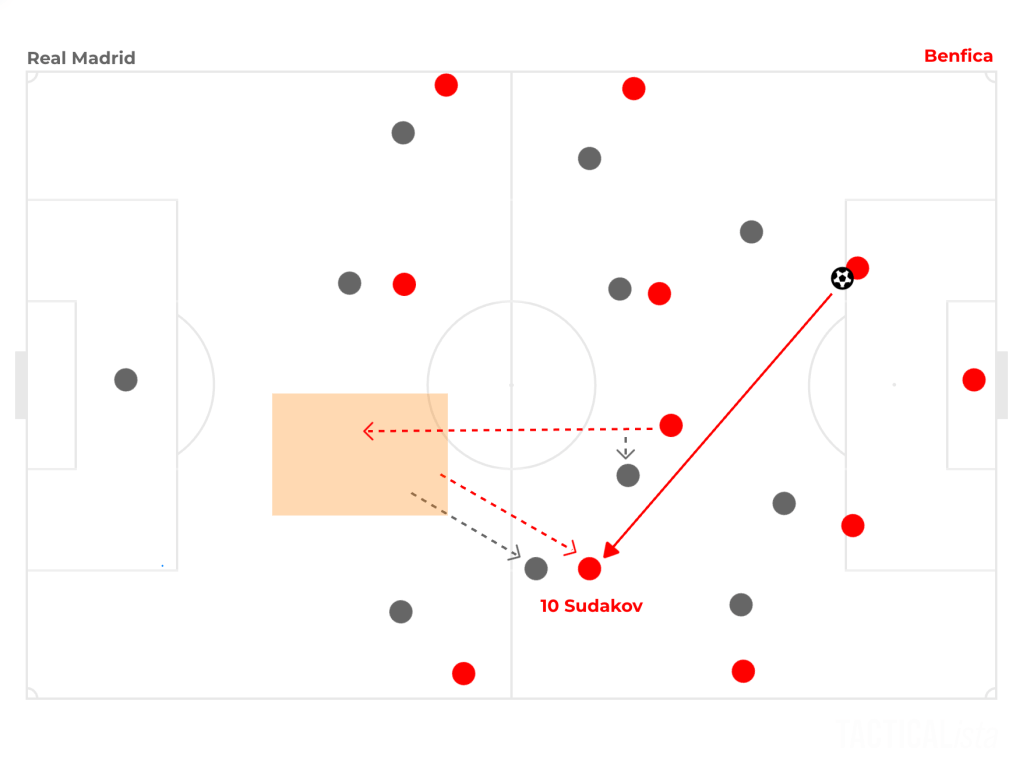
Adapting to the High Press: After Benfica scored the go-ahead goal, Madrid intensified their high press. Benfica responded brilliantly by dropping a defensive midfielder deep into the build-up structure. This intentionally triggered the press from Madrid’s winger, which in turn manufactured space out wide and allowed Benfica to smoothly progress the ball up the pitch.
2-3. Rest Defense
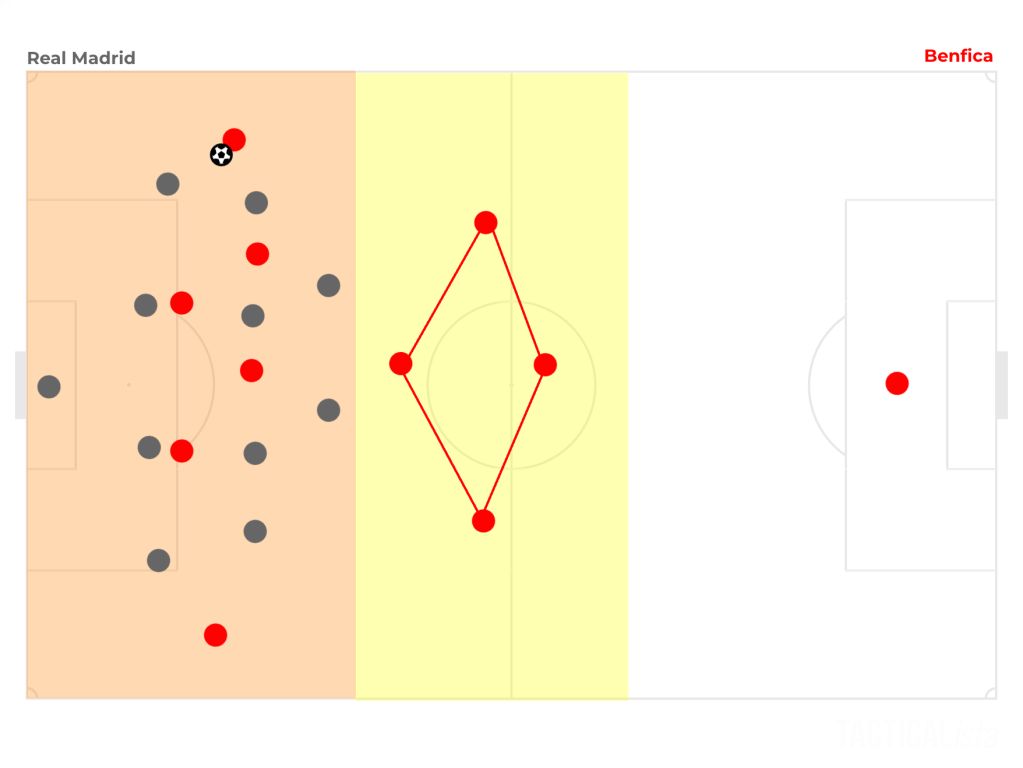
When attacking deep in the opponent’s half, Benfica implemented a strict ‘Rest Defense’ structure. Rather than committing forward to join the attack, a disciplined block of four players remained withdrawn, focusing entirely on stifling potential counter-attacks and recovering second balls (loose balls). Through this calculated positioning, they successfully neutralized the devastating pace and transitional threat of Madrid’s key forwards, Kylian Mbappé and Vinícius Júnior.
2-4. Attacking Transition Post-Set-Piece
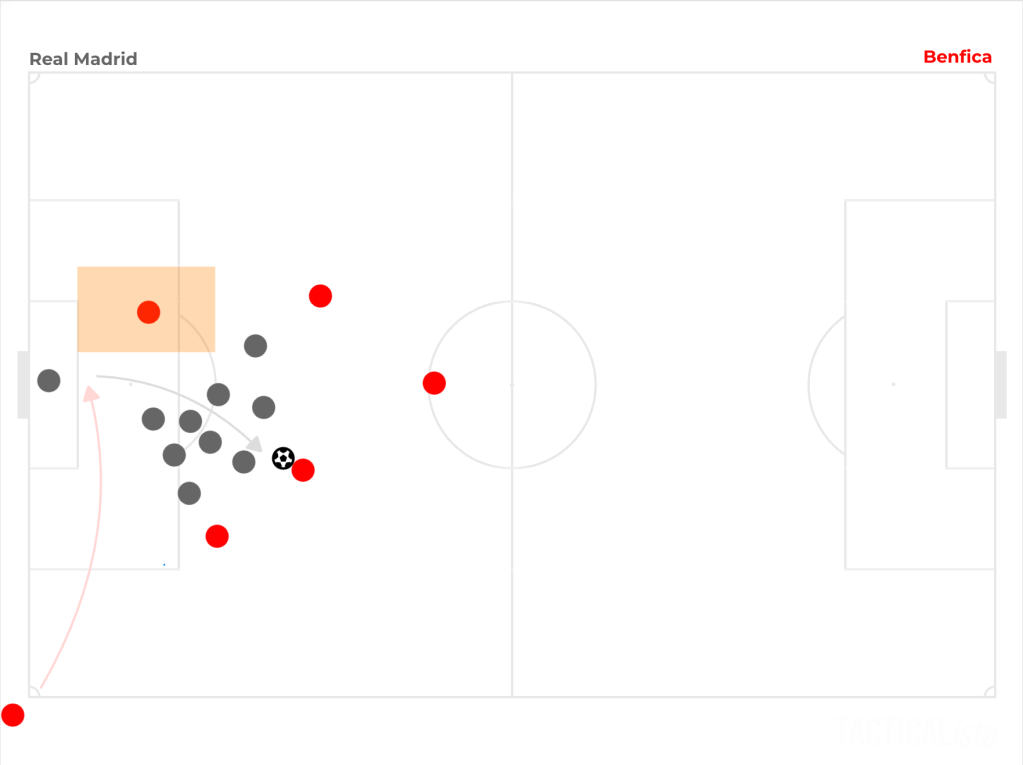
Madrid displayed a noticeably disorganized defensive structure when pushing their line higher after clearing set-pieces. Their attackers merely gravitated toward the ball, while the defenders stepped up haphazardly, completely ball-watching without resetting their defensive shape. Recognizing Madrid’s lack of communication and their tendency to bunch up in one area, Benfica ruthlessly exploited this vulnerability by rapidly playing passes into the vacated space on the far side (the weak side).
2-3. Individual Tactics
3-1. Vangelis Pavlidis (No. 14): Off-the-Ball Movement
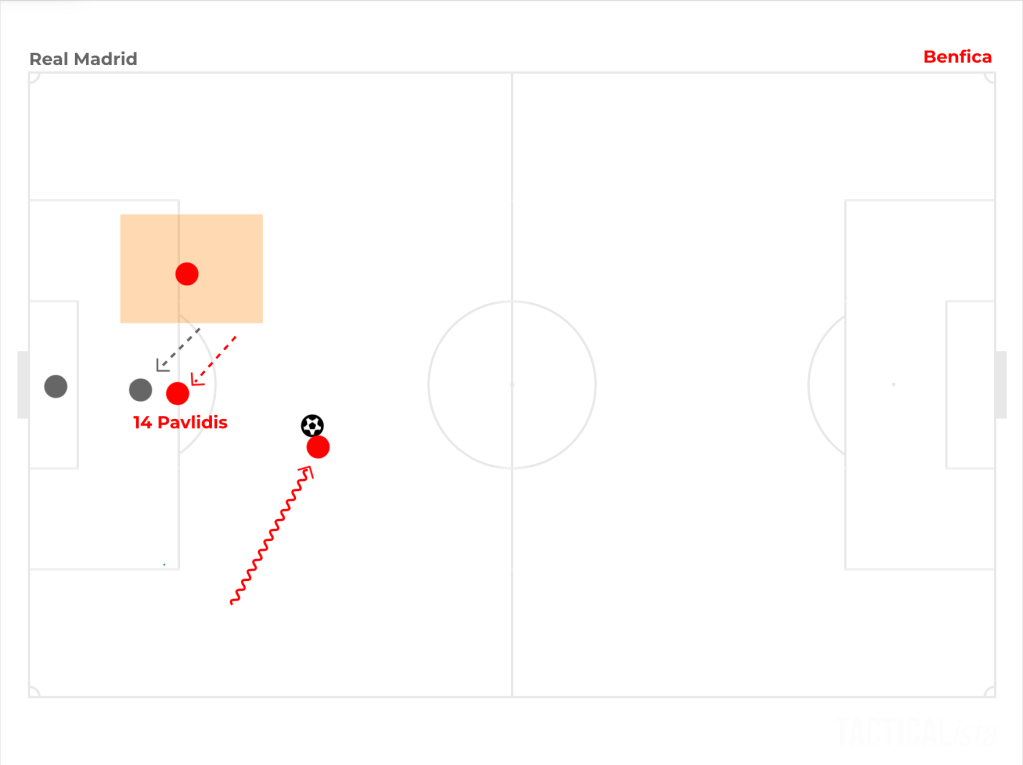
- Exploiting the Blind Side: During attacks, Pavlidis constantly positioned himself outside the center-backs’ field of vision. For example, with the ball on the right, he would perfectly position himself on the left center-back’s shoulder (the blind side).
- Pinning and Space Creation: This intelligent positioning created a constant dilemma for the defense. He actively pinned or dragged a center-back out of position, which inherently opened up valuable space for the ball carrier and nearby teammates. If the defender chose not to follow, Pavlidis was left completely unmarked and free to receive.
- Elite Football IQ over Physicality: While he lacks blistering pace or spectacular on-the-ball skills, his exceptional spatial awareness and off-the-ball intelligence were a standout feature. His ability to act as a facilitator by generating space or arriving in high-value shooting areas was highly impressive.


 touchline connect
Leave a comment